
855-277-8088

Can You Lose Money in An Annuity?

Updated July 24, 2026

You can lose money in a variable annuity and a registered index-linked annuity; you can not lose money in a fixed annuity, immediate annuity, or fixed index annuity.

Can You Lose Money In An Annuity?

Are you looking for a safe and steady way to grow your retirement savings? This annuity guide will cover which types of annuities you can lose money in and which types of annuities offer principal protection from a potential stock market downturn.

Can You Lose Money in a Variable Annuity?

Yes, you can lose your money in a variable annuity. When you purchase a variable annuity your money is invested directly in the stock market via sub-accounts; similar to a 401(k).

In addition, most variable annuities come with a fair amount of fees including:

• Sub-account fees
• M&E Fees ( mortality and expense)
• Fees for additional riders (typically lifetime income riders or death benefit riders)

Can you Lose Money in a Registered Index Linked Annuity (RILA)?

You can lose money in a registered index-linked annuity (RILA). RILA’s are a hybrid between fixed index annuities and variable annuities. 

If the stock market does have a negative year you can lose money but the amount you lose is limited by a “floor” or a “buffer.”  

In other words, when you invest in a RILA you know the most you can lose in a year, or you know that the insurance company takes on the risk for a portion of the downside e up to a certain percent.

Can You Lose Money in an Income Annuity?

Single-Premium Immediate Annuities (SPIAs) and Qualified Longevity Annuity Contracts (QLACs) convert a lump sum into an income stream that is contractually guaranteed for life or for a certain number of years.

You Can Not Lose Money in a Fixed Annuity

No, you can not lose money in a fixed annuity. Fixed annuities provide a guaranteed rate of return for a set period of time (usually 2 to 10 years).

Because of their similarity to bank certificates of deposit fixed annuities are often referred to as CD Type Annuities.

Can you Lose Money in a Fixed Index Annuity?

You can not lose money in a fixed index annuity; an index annuity guarantees that the least amount of interest you can earn in any contract year is 0%, even if the stock market crashes.

The amount of interest credited is determined by the performance of a stock market index; however, you are not directly invested in the market.

If the index goes up you will be credited with a percent of the gains and if it goes down you earn nothing and lose nothing.

Can you lose money in a Long Term Care Annuity?

You cannot lose money in a long-term care annuity as they are a type of fixed annuity.

These types of fixed annuities are designed to leverage your money to cover potential long-term care expenses rather than to accumulate interest.

Annuity Fees and Early Surrender Charges

Early Surrender Penalties

Annuities have a Contingent Deferred Surrender Charge (CDSC). This means you will pay a “surrender” fee if you liquidate your annuity contract before the end of your term.

If you’ve had experience investing in mutual funds you are likely familiar with the concept of a Contingent Deferred Sales Charge (CDSC). Investors who sell Mutual Fund Class B shares within a specified number of years from purchase are also assessed a CDSC – the same concept with an annuity.

Annuity Fees

Finally, index annuities with an optional income rider have become increasingly popular because they actually pay higher guaranteed lifetime income payments than traditional annuitization with a lot more flexibility. 

If you purchase an optional income rider you may be charged an annual fee that will be subtracted from your account value. Your account value could decrease by an amount equal to the rider fee in a year in which you earn zero interest.

Risk is only half the decision. Our guide to should I buy an annuity walks through when an annuity makes sense and when it does not.

Risk Level by Type of Annuity Comparison Chart
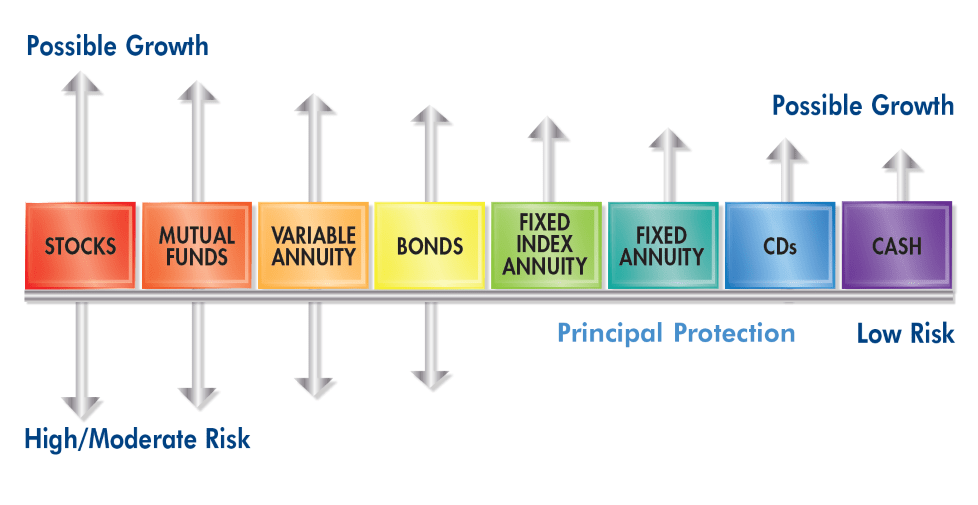
Investment continuum chart showing where an index annuity fits relative to other investment types fixed index annuity pros and cons

get an Annuity Quote

Complete the form below and we’ll email you an annuity quote within four business hours. If your request is urgent please contact us at 855-277-8088. Or you can use one of our annuity calculators here.

Get Today's Best Annuity Rates

Free quote. No obligation. 50+ top-rated carriers.

We respect your privacy. Your information is never sold.

Get a Personalized Annuity Quote
Compare 90+ top annuity companies. No obligation.
Editorial Disclosure: Our editorial team independently reviews and rates annuity products. We may earn commissions when you request a quote through our partner links. This content is for informational purposes only and does not constitute financial advice. Learn more.
Disclaimer: This content is for informational and educational purposes only. It does not constitute financial, tax, or legal advice. Annuity products vary by state and carrier. Always consult a licensed financial professional before making any financial decisions. My Annuity Store is an independent marketplace and does not provide investment advice.
Where to Go Next
Based on what you just read, here are your best next steps.

Pros and Cons of Fixed Annuities

Before you commit to a fixed annuity, weigh the advantages and drawbacks for your retirement situation.

✓  Pros

  • Guaranteed rate locked in for the full term, no surprises
  • Principal is 100% protected from market losses
  • Often pays significantly more than CDs or savings accounts
  • Tax-deferred growth, no annual tax bill until withdrawal
  • Up to 10% annual free withdrawal without surrender charge
  • State guaranty association coverage (typically up to $250,000)
  • Simple to understand, no moving parts or index tracking

✗  Cons

  • Surrender charges apply if you withdraw more than 10% early
  • Not FDIC insured. Backed by the insurance company, not the government
  • Earnings taxed as ordinary income (not capital gains rates)
  • 10% IRS early-withdrawal penalty before age 59½
  • Rate is fixed, so you won't benefit if market rates rise
  • Less liquidity than a savings account or money market

Learn more: Are annuities safe?

Compare Top MYGA Rates by Term

See today's highest guaranteed rate from a top annuity company for each term length.

See all rates →

Rates sourced from AnnuityRateWatch. Not a solicitation. Rates vary by state. Verify before purchasing.

Types of Annuities

Insurance companies offer several types of annuities to fit different financial goals. Here's how they compare.

A MYGA (Multi-Year Guaranteed Annuity) is the simplest fixed annuity. Your rate is guaranteed for the entire term of 3, 5, or 7 years. No market exposure, no index tracking. What you see is what you earn.

Best for: Savers who want a predictable, guaranteed return and are comfortable locking funds for a set term. Often compared to CDs but frequently pays more.

Learn more about MYGAs →

A Fixed Indexed Annuity (FIA) links your interest credits to a market index (like the S&P 500) with a floor of 0%, so you can never lose principal. Upside is capped via participation rates or caps.

Best for: Investors who want some market participation with a safety net. More complex than MYGAs but potentially higher returns in strong market years.

Learn more about FIAs →

A SPIA (Single Premium Immediate Annuity) converts a lump sum into a guaranteed income stream: monthly checks that start within 30 days and continue for life or a set period.

Best for: Retirees who need guaranteed income immediately and want to eliminate the risk of outliving their money. The "pension replacement" product.

Learn more about SPIAs →

A Variable Annuity invests your premium in sub-accounts (similar to mutual funds). Returns fluctuate with the market, so you can earn more but can also lose principal.

Best for: Long-term investors who want market exposure inside a tax-deferred wrapper and are comfortable with investment risk. Higher fees than fixed products.

Learn more about variable annuities →

A RILA (Registered Index-Linked Annuity) offers partial market participation with a defined buffer against losses (e.g., 10% or 20%). Unlike FIAs, RILAs can lose money, but losses are limited.

Best for: Investors willing to accept limited downside in exchange for higher upside potential than a traditional FIA. A middle ground between fixed and variable.

Learn more about RILAs →

Rate Methodology

My Annuity Store monitors MYGA rates from 90+ top annuity companies via AnnuityRateWatch. Our rate data refreshes every 6 hours.

For every product we show the carrier's AM Best financial strength rating, a measure of the insurer's ability to meet its obligations, so you can weigh the rate against the carrier's strength. We monitor carriers across the ratings spectrum and do not exclude one based on its rating.

Rates are sorted by highest guaranteed APY within each term group. Products using simple interest (SI) are labeled. The effective compound yield is lower than the stated rate. Minimum premiums shown are for non-qualified (after-tax) purchases.

Data: AnnuityRateWatch · Updated daily
People Also Read
Related guides and resources our readers find most helpful.

Explore More

2026 EDITION
The Plain-English Guide to Deferred Annuities.
myannuitystore.com
Free download

Get the 2026 Buyer’s Guide, free.

A plain-English walkthrough: the four product types, fees, riders, your rights, and the questions to ask before you sign. No sales pressure.

Instant access · No spam · We never sell your information.

You’re in. Here’s your guide.

Your download should start automatically. If it doesn’t, use the button below. We’ve also added you to our newsletter for rate updates and new guides.

Download the Guide (PDF) ↓
Get Free Quote Call Now