
How Much Life Insurance Do I Need?

Updated March 28, 2026

How Much Life Insurance Do I Need Estimator

There is no way to determine exactly just how much life insurance you need but there are a few different ways to make a very good, educated guess. 

In this guide we’ll walk you through a quick and simple process that will provide you with a very good estimate of how much insurance you should consider buying.

INCOME NEEDS

1. Annual income your family would need if you die today
Typically between 60% and 80% of total income. Include all salaries, dividends, interest, and any other sources of income. $_________

2. Annual income available to your family from other sources
Enter a number that includes dividends, interest, spouse’s earnings, and social security. $_________

3. Annual income to be replaced (subtract line 2 from line 1) $_________

4. Capital needed for income
Multiply line 3 by the appropriate factor¹ in the table below $_________

Years Income Needed101520253035404550
Factor9.413.615.418.120.422.424.125.626.9

EXPENSES

5. Funeral² and other final expenses
Typically the greater of $15,000 or 4% of your estate $_________

6. Mortgage and other debts
Include mortgage balance, credit card debt, car loans, home equity loans, etc. $_________

7. College costs³
2015-2016 average annual cost at four-year colleges and universities:
public – $19,548 (in-state); $34,031 – (out-of-state); private college – $43,921
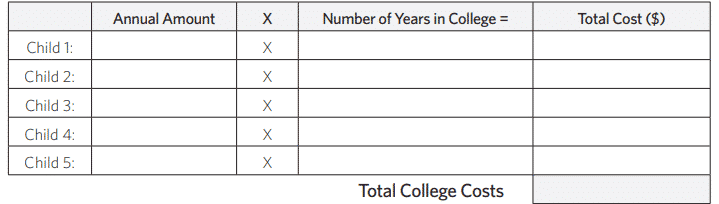
Fillable table to estimate total cost of all children's college expenses

8. Total Capital Required (Add lines 4, 5, 6 and 7) $_________

ASSETS

9. Savings and investments
Bank accounts, CDs, stocks, bonds, mutual funds, real estate/rental property, etc. $_________

10. Retirement savings
IRAs, 401(k) plans, SEPs, pension and profit sharing plans $_________

11. Present amount of the insurance
Include group insurance and personal insurance purchased on your own $_________

12. Total of assets (Add lines 9, 10 and 11) $_________

13. Estimated amount of additional life insurance needed (Subtract line 12 from line 8) $_________

¹Inflation is assumed to be 3%. The rate of return on investments is assumed to be 4.5% after tax.

²All data published on this page is based on the latest available government, industry, and research reports; data is updated as new information becomes available. The data on this page was last updated on July 18, 2019. https://nfda.org/news/statistics

³Source: The College Board, Trends in College Pricing 2015-2016. Costs include tuition, room and board, books and supplies, transportation, and other expenses. The College Costs numbers are the 2015-2016 national average for a four year college or university. College costs are indexed at 4.5%.

How Much Does Life Insurance Cost?

Once you’ve answered the, “how much life insurance do I need” question, it would seem the logical next step is to get life insurance quotes to see exactly how much it is going to cost you to get an appropriate amount of life insurance coverage to protect your family in the event of your death.

You can use our life insurance quotes online tool to get offers from multiple top rate insurers instantly.

General Rule of Thumb Method

Multiply your income by 10

The “times your income by 10” general rule of thumb is often shared online, but it doesn’t take a detailed look at your family’s needs, nor does it consider your savings or existing life insurance policies. And it doesn’t provide a coverage amount for stay-at-home parents, who should have coverage even if they don’t make an income.

If you or your spouse do not work outside of the home the value, he or she would still need to be replaced if they were to die. The surviving spouse/ remaining parent would need funds to pay someone for childcare and other responsibilities the stay-at-home parent was doing for free.

Tips for Calculating How Much Life Insurance You Need

  1. Include the appropriate amouint of life insurance in your overall financial plan and budget for the expense as part of your monthly or annual expenses.
  2. Don’t go too light – better to error on the high side.
  3. Discuss this important decision with your spouse or significant other
  4. Consider buying two or three smaller policies instead of a single larger life insurance policy.
Get Today's Best MYGA Rates
Compare A-rated carriers. Rates up to 6.50%. No obligation.
Editorial Disclosure: Our editorial team independently reviews and rates annuity products. We may earn commissions when you request a quote through our partner links. This content is for informational purposes only and does not constitute financial advice. Learn more.
Disclaimer: This content is for informational and educational purposes only. It does not constitute financial, tax, or legal advice. Annuity products vary by state and carrier. Always consult a licensed financial professional before making any financial decisions. My Annuity Store is an independent marketplace and does not provide investment advice.
Where to Go Next
Based on what you just read, here are your best next steps.

Pros and Cons of Fixed Annuities

Before you commit to a fixed annuity, weigh the advantages and drawbacks for your retirement situation.

✓  Pros

  • Guaranteed rate locked in for the full term, no surprises
  • Principal is 100% protected from market losses
  • Often pays significantly more than CDs or savings accounts
  • Tax-deferred growth, no annual tax bill until withdrawal
  • Up to 10% annual free withdrawal without surrender charge
  • State guaranty association coverage (typically up to $250,000)
  • Simple to understand, no moving parts or index tracking

✗  Cons

  • Surrender charges apply if you withdraw more than 10% early
  • Not FDIC insured. Backed by the insurance company, not the government
  • Earnings taxed as ordinary income (not capital gains rates)
  • 10% IRS early-withdrawal penalty before age 59½
  • Rate is fixed, so you won't benefit if market rates rise
  • Less liquidity than a savings account or money market

Learn more: Are annuities safe?

Compare Top MYGA Rates by Term

See today's highest guaranteed rate from an A-rated carrier for each term length.

See all rates →

Rates sourced from AnnuityRateWatch. A-rated carriers (AM Best) only. Not a solicitation. Rates vary by state. Verify before purchasing.

Types of Annuities

Insurance companies offer several types of annuities to fit different financial goals. Here's how they compare.

A MYGA (Multi-Year Guaranteed Annuity) is the simplest fixed annuity. Your rate is guaranteed for the entire term of 3, 5, or 7 years. No market exposure, no index tracking. What you see is what you earn.

Best for: Savers who want a predictable, guaranteed return and are comfortable locking funds for a set term. Often compared to CDs but frequently pays more.

Learn more about MYGAs →

A Fixed Indexed Annuity (FIA) links your interest credits to a market index (like the S&P 500) with a floor of 0%, so you can never lose principal. Upside is capped via participation rates or caps.

Best for: Investors who want some market participation with a safety net. More complex than MYGAs but potentially higher returns in strong market years.

Learn more about FIAs →

A SPIA (Single Premium Immediate Annuity) converts a lump sum into a guaranteed income stream: monthly checks that start within 30 days and continue for life or a set period.

Best for: Retirees who need guaranteed income immediately and want to eliminate the risk of outliving their money. The "pension replacement" product.

Learn more about SPIAs →

A Variable Annuity invests your premium in sub-accounts (similar to mutual funds). Returns fluctuate with the market, so you can earn more but can also lose principal.

Best for: Long-term investors who want market exposure inside a tax-deferred wrapper and are comfortable with investment risk. Higher fees than fixed products.

Learn more about variable annuities →

A RILA (Registered Index-Linked Annuity) offers partial market participation with a defined buffer against losses (e.g., 10% or 20%). Unlike FIAs, RILAs can lose money, but losses are limited.

Best for: Investors willing to accept limited downside in exchange for higher upside potential than a traditional FIA. A middle ground between fixed and variable.

Learn more about RILAs →

Rate Methodology

My Annuity Store monitors MYGA rates from over 50 A-rated insurance carriers via AnnuityRateWatch. Our rate data refreshes every 6 hours.

To make our list, a carrier must be rated A− or better by AM Best, a financial strength rating that indicates the insurer's ability to meet obligations. Carriers with ratings of B++ or lower are excluded regardless of how attractive their rate appears.

Rates are sorted by highest guaranteed APY within each term group. Products using simple interest (SI) are labeled. The effective compound yield is lower than the stated rate. Minimum premiums shown are for non-qualified (after-tax) purchases.

Data: AnnuityRateWatch · A-rated carriers only · Updated daily
People Also Read
Related guides and resources our readers find most helpful.

Explore More

Get Free Quote Call Now