
Annuities carry several layers of fees that can meaningfully reduce your returns over time. Some are disclosed upfront. Others are embedded in the product structure and easy to overlook. This page breaks down every major cost category – what each fee is, typical ranges, and how to evaluate whether a product’s fee structure is reasonable for what you’re getting.
What Fees Do Annuities Charge?
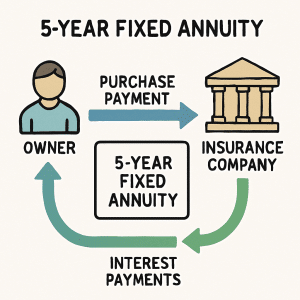
The fees you pay depend heavily on the annuity type. A simple 5-year MYGA (multi-year guaranteed annuity) has essentially no ongoing fees – the carrier builds its margin into the rate spread. A variable annuity with an income rider can carry 3% or more in annual charges. Here’s a complete breakdown by fee type.
Surrender Charges
A surrender charge is a penalty for withdrawing more than the allowed free withdrawal amount before the surrender period ends. Most fixed and fixed index annuities have surrender periods of 5 to 10 years. Variable annuities typically run 7 years.
Surrender charges usually start high and step down each year. A typical 7-year schedule might look like: 8%, 7%, 6%, 5%, 4%, 3%, 2%, 0%. On a $200,000 contract in year one, an 8% surrender charge equals $16,000 – a significant penalty.
Most contracts include a free look period (typically 10 to 30 days) during which you can cancel without penalty. After that, the surrender schedule applies.
What to look for: Compare surrender periods across similar products. Identical rates with a 7-year vs. 5-year surrender period represent a real tradeoff in liquidity. Also verify what triggers a waiver – most contracts waive surrender charges if you’re confined to a nursing home or diagnosed with a terminal illness.
Free Withdrawal Provisions
Most annuities allow you to withdraw 10% of your contract value (or sometimes 10% of the original premium) each year without triggering a surrender charge. Some contracts allow interest-only withdrawals from day one. A few offer 15% or 20% free withdrawals in exchange for a slightly lower rate.
Free withdrawal amounts do not typically roll over. If you don’t use your 10% allowance in year two, it doesn’t add to your year three limit.
Mortality and Expense (M&E) Fees
M&E fees apply almost exclusively to variable annuities. They compensate the insurance company for the mortality risk it accepts and cover general operating expenses. Typical M&E fees range from 0.60% to 1.40% of the contract value per year.
On a $300,000 variable annuity with a 1.25% M&E fee, you’re paying $3,750 per year before any fund-level expenses. This is deducted from your sub-account value, not charged directly.
Sub-Account (Fund) Expenses
Variable annuities invest in sub-accounts that function similarly to mutual funds. Each sub-account carries its own expense ratio – typically 0.50% to 1.50% annually. These fees are in addition to the M&E fee.
A variable annuity with a 1.25% M&E fee and sub-accounts averaging 0.90% in expenses carries a base cost of 2.15% per year before any rider fees. That’s the starting point before you add income or death benefit riders.
Administrative Fees
Many variable annuities charge a flat annual administrative fee – typically $25 to $50 per year, sometimes expressed as a percentage (0.10% to 0.30%). Some carriers waive this fee once the contract value exceeds a certain threshold (often $50,000 or $100,000).
Fixed and fixed index annuities generally do not charge explicit administrative fees. The carrier’s operating costs are built into the rate or the spread.
Rider Fees
Riders are optional add-ons that provide additional guarantees – usually a guaranteed lifetime withdrawal benefit (GLWB), an enhanced death benefit, or a long-term care benefit. Each rider adds to your annual cost.
| Rider Type | Typical Annual Cost | What It Does |
|---|---|---|
| Guaranteed Lifetime Withdrawal Benefit (GLWB) | 0.75% – 1.50% | Guarantees a minimum annual withdrawal for life, regardless of account performance |
| Enhanced Death Benefit | 0.25% – 0.60% | Guarantees heirs receive at least the original premium or a stepped-up value |
| Long-Term Care / Confinement Benefit | 0.25% – 0.50% | Doubles or increases income payments if you’re confined to a care facility |
| Return of Premium Death Benefit | 0.10% – 0.30% | Guarantees beneficiaries receive at least the original premium if you die before annuitizing |
Rider fees on variable annuities are typically charged against the contract value (reducing your accumulation). On fixed index annuities, some riders charge against the contract value while others charge against the income base – an important distinction since the income base is often higher.
Read our full guide to income riders and GLWBs if you’re evaluating lifetime income guarantees.
Spread, Cap, and Participation Rate as Implicit Costs
Fixed index annuities don’t charge explicit management fees. Instead, the carrier limits how much index-linked growth you can capture. These limits are the carrier’s compensation for providing principal protection and absorbing market risk.
- Cap rate: The maximum interest you can earn in a given period. If the S&P 500 returns 18% and your cap is 9%, you earn 9%.
- Participation rate: The percentage of index gains you receive. A 60% participation rate on a 15% index gain credits 9% to your account.
- Spread: A percentage subtracted from the index gain. A 2% spread on a 10% gain credits 8%.
These are not fees in the traditional sense – you can’t see them on a statement line item – but they represent the cost of the guarantee. A higher cap or participation rate generally means you’re getting better value from the product’s structure.
What Are Annuity Commissions?
Annuity commissions are paid by the insurance carrier to the selling agent or financial advisor. You do not pay commissions directly – they come out of the carrier’s general account, not your contract value.
That said, commissions do influence product design. Higher-commission products sometimes have longer surrender periods or lower cap rates because the carrier needs to recoup the upfront payout over time.
Typical Annuity Commission Rates
| Annuity Type | Typical Commission Range |
|---|---|
| MYGA (3-7 year) | 1% – 3% |
| Fixed Index Annuity | 4% – 8% |
| Variable Annuity | 4% – 7% |
| Single Premium Immediate Annuity (SPIA) | 1% – 3% |
| Deferred Income Annuity (DIA) | 2% – 4% |
On a $250,000 fixed index annuity with a 6% commission, the agent receives $15,000. This does not reduce your $250,000 contract value – it is paid separately by the carrier.
Important note: Some fee-based advisory platforms offer lower-commission or commission-free annuity versions in exchange for a direct advisory fee. These products sometimes offer better cap rates or participation rates since the carrier isn’t funding an upfront commission.
How to Compare Total Annuity Costs
When comparing annuities, focus on the all-in cost, not just one fee in isolation.
- For MYGAs: The rate is the return. No additional fees to calculate. Compare rates, surrender periods, and carrier ratings side by side.
- For fixed index annuities: Evaluate cap rates, participation rates, and rider fees together. A product with a 10% cap and no rider is often better than one with a 7% cap and a rider you don’t need.
- For variable annuities: Add M&E + administrative + sub-account + rider fees. The total cost of ownership often runs 2.5% to 4% annually. That’s a meaningful drag on growth.
Ask for the product’s full disclosure document and look for the “charges and fees” section before purchasing. Every annuity sold in the U.S. is required to provide a complete fee disclosure.
Are Annuity Fees Worth It?
It depends on what you’re buying. A MYGA with no ongoing fees that pays 5.50% guaranteed for 5 years is straightforward value. A variable annuity with 3% in annual fees needs to generate significantly higher returns just to break even versus a lower-cost alternative.
The question to ask is: what does each fee buy you? A GLWB rider charging 1.10% per year provides a guaranteed income floor that no CD or bond can match. That may be worth the cost for a retiree who needs certainty. For an accumulation-focused buyer in their 50s, the same rider may be unnecessary overhead.
Work with an independent agent who can show you multiple products side by side with full fee disclosure. My Annuity Store compares options from 30+ carriers. Request a free quote or call 855-583-1104.
Frequently Asked Questions
Do all annuities have fees?
No. MYGAs and traditional fixed annuities typically have no explicit ongoing fees – the carrier’s margin is built into the interest rate spread. Variable annuities and fixed index annuities with optional riders do carry fees, which are disclosed in the product prospectus or disclosure document.
How do I find out what fees an annuity charges?
Request the full product disclosure or prospectus before purchasing. The charges and deductions section will list every fee by name and amount. Your agent is required to provide this document. If they won’t, that’s a red flag.
Can annuity fees be negotiated?
Generally no – annuity pricing is set by the carrier and is the same across all agents selling that product. What you can do is compare multiple products to find the best combination of rate, fee structure, and features for your situation.
Do annuity fees reduce my principal?
Surrender charges reduce your net payout if you withdraw early. Rider fees and M&E fees on variable annuities are typically deducted from your contract value, which reduces accumulation over time. Free withdrawal allowances (usually 10% per year) let you access funds without triggering surrender charges.
Related Reading
- Annuity Income Riders: How GLWBs Work
- What Are Annuity Surrender Charges?
- The Free Look Period Explained
- Best Fixed Annuity Rates Today
- Browse Carrier Reviews
Sources & Citations
- FINRA. “Variable Annuities: Beyond the Hard Sell.” finra.org
- SEC. “Variable Annuities: What You Should Know.” sec.gov
- NAIC. “Buyer’s Guide for Deferred Annuities.” naic.org
- IRS. “Publication 575: Pension and Annuity Income.” irs.gov
- NAIC. “Suitability in Annuity Transactions Model Regulation.” naic.org