

How Does Compound Interest Grow Your Money?
Compound interest grows your money by paying you interest on both your original principal and the interest you have already earned. At 6% compounded annually, $10,000 grows to about $17,908 in 10 years and about $32,071 in 20 years. The longer your money compounds, the faster it grows, because each year you earn interest on a larger and larger balance. Use the calculator below to see how your own starting amount, rate, and time horizon stack up.
How to Use the Compound Interest Calculator
- Enter your principal. Type in the starting amount you plan to invest or save, such as $10,000 or $100,000.
- Enter your interest rate. Put in the annual rate you expect to earn, for example 6%. Keep it realistic for the product you are comparing.
- Set your time and compounding frequency. Choose how many years the money will grow and how often interest compounds (daily, monthly, quarterly, or annually). Then read the projected ending balance.
What Is Compound Interest?
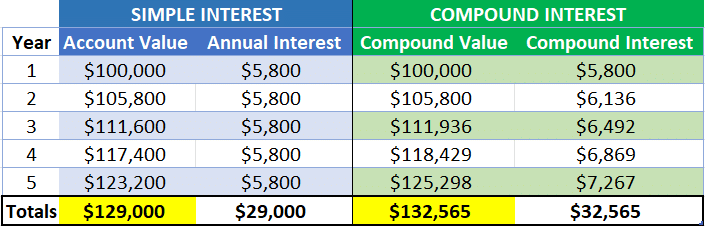
Compound interest, often called interest on interest, adds each period’s earned interest back to your principal so that future interest is calculated on the larger balance. Simple interest, by contrast, is paid only on your original principal. That difference is small at first but becomes powerful over time, much like a snowball that grows as it rolls downhill.
Three factors drive how much you end up with: the amount you start with (principal), the rate you earn, and the length of time the money compounds. Of the three, time usually does the heaviest lifting. A modest balance left alone for decades can outgrow a larger balance that has only a few years to work.
Taxable Savings vs Tax-Deferred Annuity at the Same Rate
Two accounts can earn the exact same rate and still leave you with very different amounts, because of taxes. In a taxable savings account or CD, the interest you earn each year is reported as income and taxed that year, even if you leave it in the account. Paying tax annually shrinks the balance that compounds, so you are compounding a smaller number every year.
Inside a tax-deferred annuity such as a multi-year guaranteed annuity (MYGA), no tax is due on the growth until you withdraw it. The full balance keeps compounding year after year. At the same stated rate, tax-deferred compounding inside a MYGA beats a taxable account, because nothing leaks out to taxes along the way. You still owe ordinary income tax when you eventually take the money out, but until then the entire balance is working for you.
To compare after-tax outcomes directly, the CD vs annuity calculator shows how a taxable CD and a tax-deferred annuity at similar rates end up after taxes. The simple vs compound interest calculator isolates the compounding effect on its own.
How Carol uses the calculator. Carol is 58 and has $50,000 in a savings account earning very little. She is deciding between leaving it in a taxable account and moving it into a 5-year MYGA. She enters $50,000 as her principal, 5.5% as her rate, and 5 years, with annual compounding.
The calculator shows her balance growing to roughly $65,300 after five years if nothing is taxed along the way. In a taxable account at the same rate, part of each year’s interest would go to taxes, leaving her with less. Because she does not need this money for at least five years and is in a fairly high tax bracket, Carol decides the tax-deferred MYGA is the better home for it.
She also runs the numbers at 10 years and sees the gap widen, which confirms that the longer she leaves the money untouched, the more the tax deferral is worth.
Why Time Matters More Than You Think
Because compounding builds on itself, the back half of a long time horizon adds far more dollars than the front half. Using the rule of 72, money at 6% doubles roughly every 12 years (72 divided by 6). So $10,000 at 6% is worth about $20,100 after 12 years, but it does not stop there. By year 20 it is near $32,000, and the yearly gains keep getting bigger because the balance keeps getting bigger.
This is the core reason fixed annuities and MYGAs appeal to savers who want growth they do not have to manage. You lock in a rate, let it compound tax-deferred, and time does the work. You can review current fixed annuity rates to see what rate you could lock in today, or use the fixed annuity calculator to project a specific contract. For more on how annuities work as a savings and income tool, the SEC’s investor.gov guide to annuities is a plain-English starting point.
When you are ready to compare your options, browse the full set of tools on the annuity calculators hub.
Frequently Asked Questions
What is the rule of 72?
The rule of 72 is a quick way to estimate how long it takes money to double at a fixed rate. Divide 72 by the annual interest rate to get the approximate number of years. At 6%, money doubles in about 12 years (72 divided by 6). At 8%, it doubles in about 9 years. It is an approximation, but it is close enough for fast planning.
What is the difference between compound interest and simple interest?
Simple interest is paid only on your original principal. Compound interest is paid on your principal plus all the interest you have already earned, so your balance grows faster over time. At $10,000 and 6% for 20 years, simple interest would add $12,000, while compound interest would add about $22,000. The longer the time horizon, the bigger the gap.
Does compounding frequency matter?
Yes, but less than most people expect. More frequent compounding (daily or monthly versus annually) produces a slightly higher ending balance at the same stated rate, because interest starts earning interest sooner. The difference is usually small compared with the effect of your rate and your time horizon. The annual percentage yield (APY) already reflects the compounding frequency, so comparing APYs is the cleanest way to compare two products.
How does tax deferral boost compounding?
In a taxable account, you pay tax on interest each year, which reduces the balance that compounds going forward. In a tax-deferred annuity, no tax is due until you withdraw, so the full balance keeps compounding. At the same rate, tax-deferred compounding ends with more money because nothing leaks out to taxes along the way. You still owe ordinary income tax when you take the money out, but the deferral lets a larger balance work for you in the meantime.