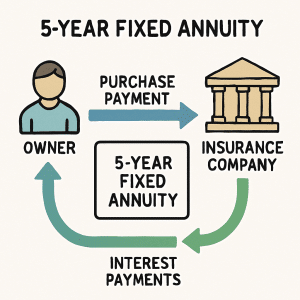


What Is a 10-Year Fixed Annuity?
A 10-year fixed annuity pays a guaranteed interest rate for a full 10 years. If you are not ready to commit for a decade, visit our fixed annuity rates page to compare every available term.
After the initial 10-year guarantee period, you can renew for another term at the new declared rate, withdraw your account value, convert the contract to monthly income payments, or transfer to a new annuity through a tax-free 1035 exchange.
Beyond the guaranteed return, a 10-year fixed annuity can turn your savings into lifelong, pension-like income. The rate guarantee is backed by the financial strength of the issuing insurance company.
A fixed annuity is also known by several other names:
- CD-type annuity
- Multi-Year Guaranteed Annuity (MYGA)
- Single-Premium Deferred Annuity (SPDA)
- Traditional Fixed Annuity
- Flexible-Premium Deferred Annuity (FPDA)
How 10-Year Fixed Annuities Work
Accumulation phase. You pay a premium to the insurance company, and the money grows at a guaranteed interest rate. The interest is tax-deferred, so you do not pay taxes on the earnings until you withdraw them.
Annuitization (payout) phase. After the accumulation period, you can convert the contract into a series of fixed, predictable payments, either for a set number of years or for life, guaranteed not to fall below a stated level.
Key Features
- Guaranteed return: a fixed rate with principal protection, unaffected by market swings.
- Tax-deferred growth: earnings are not taxed until you withdraw them.
- Predictable income: a guaranteed income stream you can turn on in retirement.
- Liquidity: less liquid than some options because of surrender charges on early withdrawals.
- Surrender charges: penalties may apply if you withdraw more than the annual free amount before the surrender period ends.
- Inflation risk: a fixed rate may not keep pace with inflation over a full decade.
Fixed Annuities vs. CDs
Fixed annuities work much like a certificate of deposit (CD). Both protect your principal, so your account value will not fall because of market performance.
A fixed annuity, or MYGA, guarantees a set interest rate for a specified period, just like a CD. The difference is that fixed annuity guarantees are backed by the claims-paying ability of the issuing insurance company and are not insured by the FDIC1 the way a CD is.
While not FDIC-insured, state insurance guaranty associations provide a safety net for annuity policyholders in their state, continuing coverage up to the limits set by state law2 even if an insurer becomes insolvent.
What Happens at the End of a 10-Year Fixed Annuity?
At maturity you have a few choices. One is to compare current fixed annuity rates and make a tax-free transfer to a new annuity at a different insurance company through a 1035 exchange.
Section 1035 of the Internal Revenue Code lets you exchange an annuity you own for a new annuity without paying tax on the investment gains earned in the original contract3, which can be a substantial benefit. A few rules apply:
- The old annuity must be exchanged directly for the new policy. You cannot take a check and apply the proceeds yourself.
- You can 1035 exchange from a life insurance policy to an annuity.
- You can 1035 exchange from an annuity to a long-term care policy.
- You cannot 1035 exchange from an annuity to a life insurance policy.
10-Year Fixed Annuity Rate FAQs
What is a 10-year fixed annuity?
A 10-year fixed annuity guarantees a fixed interest rate for 10 years. Your principal is protected, interest grows tax-deferred, and the insurer backs the guarantee with its claims-paying ability.
How is interest credited on a fixed annuity?
Most MYGAs credit a declared rate that compounds annually; some offer a simple-interest option. Contract specifics vary by carrier, so always review the disclosure for compounding details and renewal provisions.
Can I access my money during the 10-year term?
Most fixed annuities allow limited penalty-free withdrawals, often 10% of the account value each year, after the first year. Larger withdrawals may incur surrender charges and a possible market value adjustment. Features vary by insurer and state.
What happens at the end of the 10 years?
Growth is tax-deferred until withdrawn, and distributions are generally taxed as ordinary income. Withdrawals before age 59½ may incur a 10% IRS penalty in addition to ordinary income tax. Consult your tax professional for your situation.
How are taxes handled?
Interest grows tax-deferred. Withdrawals are taxed as ordinary income and may face a 10% IRS penalty if taken before age 59½. Non-qualified funds, IRAs, and Roth IRAs each have different tax treatment, so confirm with a tax professional.
Are there fees in a 10-year fixed annuity?
There are typically no explicit annual fees; costs are priced into the credited rate. Surrender charges can apply if you withdraw more than the free amount during the term.
What is a Market Value Adjustment (MVA)?
An MVA can adjust your surrender value up or down if you take excess withdrawals during the term, based on how interest rates have moved since you bought the contract4. If rates rose, the MVA may reduce value; if rates fell, it may increase it.
How do RMDs work with a 10-year annuity?
If the annuity is held in a qualified account such as an IRA, required minimum distributions must still be taken each year once you reach your RMD age. Most MYGAs allow RMD withdrawals without surrender charges, but you may need to elect that feature or coordinate with the carrier. Always verify the contract’s RMD provisions to avoid penalties.
Related Pages
- Best Fixed Annuity Companies — a ranked shortlist for shoppers who value guarantees and simple terms.
- How to Buy an Annuity (Step-by-Step) — exactly what to expect from quote to application.
- How Much Does a $500,000 Annuity Pay Per Month? — what a $500K annuity pays and which type pays the most.
- Today’s Fixed Annuity Rates — compare 500+ products, updated live every 30 minutes.
Sources
This page draws on primary industry and regulatory sources. Figures are current as of the last update.