FAQ | Most Frequently Asked Questions about Annuities (2026)
Written by Jason Caudill, MBA
· Edited by My Annuity Store Editorial Team
Updated March 31, 2026 |
8 min read
Frequently Asked Questions About Multi-Year Guaranteed Annuities (MYGAs)
Below are the questions real clients ask us before (and after) purchasing a Multi-Year Guaranteed Annuity. Expand any topic. Nothing here is personalized advice—always evaluate your own liquidity needs, time horizon, tax situation, and overall plan.
Basics
1. What is a MYGA?
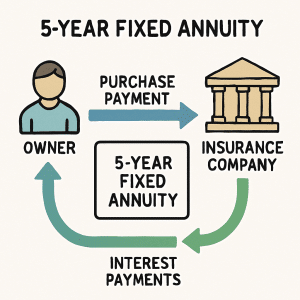
A MYGA (Multi-Year Guaranteed Annuity) is a fixed deferred annuity that guarantees an interest rate for a set term (commonly 2–10 years). Interest accrues tax‑deferred until you withdraw or the contract annuitizes.
2. How is a MYGA different from a CD?
Both guarantee principal (subject to insurer solvency for the MYGA). Key differences:
Taxation: CDs typically generate annual 1099-INT; MYGA interest defers until withdrawal (non-qualified money).
Insurance Backing: CDs = FDIC (up to limits). MYGAs rely on the insurer’s claims‑paying ability plus state guaranty association coverage (limits vary by state—not FDIC).
Liquidity: Both can penalize early withdrawals; MYGAs use surrender charges & possibly a Market Value Adjustment (MVA).
Minimums: MYGAs often higher ($5k–$100k typical minimum) vs low CD minimums.
3. How does a MYGA differ from a Fixed Indexed Annuity (FIA)?
A MYGA credits a stated guaranteed rate for the full term. An FIA credits interest linked to an index (caps/spreads/participation) with upside potential but no guaranteed multi-year fixed rate beyond declared strategy terms. FIAs may offer additional features but add complexity.
4. Who is a MYGA generally suitable for?
Someone seeking: (a) principal protection, (b) a known multi‑year yield, (c) tax deferral on non‑qualified funds, (d) a defined holding period, and (e) a conservative “parking” or ladder component within a broader retirement or income plan. Not ideal if you need frequent liquidity, want equity‑like upside, or may need the money earlier than the surrender schedule allows.
Rates & Growth
5. Are MYGA rates guaranteed for the entire term?
Yes. The declared multi‑year rate is contractually guaranteed for the stated term. After maturity, renewal rates are not guaranteed and you can choose to withdraw, 1035 exchange, renew, or annuitize.
6. How are MYGA rates set?
Insurers consider prevailing interest rates, portfolio yields, expected expenses, capital requirements, and competitive positioning. Rates can change frequently for new purchases; a “rate lock” period (often 30–45 days after application/transfer) may apply once you submit paperwork and funds are in process.
7. What happens at the end of the term (maturity)?
You typically receive a window (e.g., 30 days) to:
Withdraw without surrender charges
Renew into an available rate term
Execute a 1035 exchange to another annuity
Annuitize (convert to an income stream)
If you do nothing, many contracts auto-renew—always read the maturity notice.
Liquidity & Access
8. Can I withdraw money during the term?
Most MYGAs allow limited “free withdrawals” (often 10% of accumulation value annually) starting in year 1 or 2. Larger withdrawals during the surrender period may incur surrender charges and, if applicable, an MVA. Always confirm the contract’s specific provisions.
9. What is a Market Value Adjustment (MVA)?
An MVA adjusts the amount received on certain early withdrawals, reflecting interest rate changes since purchase. If rates fell, it can increase your payout; if rates rose, it can decrease it. It does not apply at maturity or to free‑withdrawal amounts (per contract terms).
10. Can I use a MYGA for short-term cash needs?
Generally no. Only place funds you can commit for the entire surrender period, aside from permitted free withdrawals. Keep an emergency cash reserve elsewhere.
Taxes & Accounts
11. How is interest taxed in a non-qualified MYGA?
Interest accumulates tax‑deferred. Taxable ordinary income is recognized when you take withdrawals (LIFO rules apply—earnings out first). Gains withdrawn before age 59½ may face a 10% IRS penalty (non-qualified funds). Always consult a tax professional.
12. How do Required Minimum Distributions (RMDs) work with MYGAs in IRAs?
The contract value is included in your IRA total for RMD calculation. You can generally take an RMD directly from the MYGA (counting against any free withdrawal allowance) or satisfy your total RMD from another IRA. Coordinate timing to avoid surrender charges.
13. Does a MYGA issue a 1099 each year?
Non‑qualified: No 1099-INT annually while interest remains deferred. A 1099-R is issued for taxable distributions. Qualified (IRA): Distributions are reported per normal IRA rules. At death, beneficiaries also receive appropriate tax reporting on gains.
Safety & Guarantees
14. Are MYGAs FDIC insured?
No. Guarantees rely on the issuing insurer’s financial strength. State guaranty association coverage may offer a safety net subject to statutory limits (varies by state; not a substitute for FDIC). Do not base a purchase solely on guaranty coverage—evaluate carrier ratings and diversification.
15. What if the insurance company is downgraded?
A downgrade doesn’t void guarantees but signals increased risk. Actions can include monitoring further changes, considering partial 1035 exchanges at or after surrender periods, or diversifying future deposits. Sudden moves inside a surrender schedule could trigger charges—balance risk vs cost.
Planning & Strategy
16. What is a MYGA ladder and why build one?
A ladder is owning multiple MYGAs with staggered maturities. Benefits:
Mitigates reinvestment timing risk
Creates periodic liquidity points
Captures potentially higher long-term rates while keeping near-term flexibility
As contracts mature, you can reinvest at current rates or reallocate to other goals.
17. Can I convert a MYGA to lifetime income later?
Yes. Most (not all) fixed deferred annuities allow annuitization options (life, period certain, etc.) at or after the surrender period. Some people instead 1035 exchange into an immediate annuity or an income-focused product when the time comes. Compare payout rates before committing.
18. When does a 1035 exchange make sense?
Potentially when an existing non‑qualified annuity has: low crediting rate with minimal surrender left, no valuable riders you’d lose, and a markedly better available MYGA yield. Suitability requires documenting pros/cons (fees, surrender, benefits lost vs gained).
Process & Logistics
19. What are the typical minimums and maximums?
Common minimums: $5,000–$25,000 (varies by carrier/state). Maximums can range from $1M to higher with home‑office approval. Larger deposits sometimes require financial suitability review or more documentation.
20. Are there annual fees?
Standard MYGAs typically have no explicit annual policy fee; insurer expenses are embedded in the credited rate. If you see added riders, review their cost and benefit.
21. How are agents/commissions paid?
The insurer pays a one‑time commission to the writing agency; it does not directly reduce your stated guaranteed rate after issue. Nonetheless, different carriers weigh compensation in rate-setting—important to shop objectively.
22. How fast can I lock a rate?
Once your application is submitted (and any transfer paperwork initiated) most carriers honor the rate in effect on the “date in good order” for a limited lock window (commonly 30–45 days). If funds arrive after the window and rates fell, some carriers honor; others credit the new lower rate—always verify the carrier’s rate lock policy.
23. What documents will I receive?
Expect: application copy or e‑signature packet, policy/contract, schedule pages showing rate & guarantees, delivery receipt (sometimes), and periodic statements (annual or quarterly depending on carrier). Keep originals with your estate documents.
24. What happens if I withdraw before age 59½ (non-qualified)?
Earnings withdrawn are ordinary income and may face a 10% IRS penalty if you are under 59½ unless an exception applies (consult a tax professional). Additionally, surrender charges/MVA could reduce the amount received.
25. Is there any inflation protection?
A standard MYGA credits a fixed nominal rate; it does not automatically adjust for inflation. You can mitigate inflation risk with a ladder (stagger maturities to periodically reset rates) or by pairing MYGAs with growth/real asset allocations elsewhere in the portfolio.
Disclaimer: This FAQ is general education—not individualized tax, legal, or investment advice. Guarantees are subject to the issuing insurer’s financial strength. State guaranty association protections vary and are not a substitute for FDIC insurance. Review the contract, disclosure documents, and your own financial plan before purchasing or exchanging an annuity.
Compare Annuity Rates
Considering purchasing an annuity? Visit our online annuity marketplace and compare today’s fixed annuity rates in real-time.
Editorial Disclosure: Our editorial team independently reviews and rates annuity products. We may earn commissions when you request a quote through our partner links. This content is for informational purposes only and does not constitute financial advice. Learn more.
Disclaimer: This content is for informational and educational purposes only. It does not constitute financial, tax, or legal advice. Annuity products vary by state and carrier. Always consult a licensed financial professional before making any financial decisions. My Annuity Store is an independent marketplace and does not provide investment advice.
Live Data · Updated Daily
Featured Retirement Savings Products for April 2, 2026
Rates updated: April 2, 2026, 10:45 am ETSource: AnnuityRateWatch
Rates shown are for informational purposes only and subject to change without notice.
Products marked SI use simple interest — effective compound yield is lower than the stated rate.
Minimum premiums shown are for non-qualified (after-tax) funds.
Always verify current rates with a licensed annuity professional before purchasing.
Rates updated: April 2, 2026, 10:45 am ETSource: AnnuityRateWatch
Rates shown are for informational purposes only and subject to change without notice.
Products marked SI use simple interest — effective compound yield is lower than the stated rate.
Minimum premiums shown are for non-qualified (after-tax) funds.
Always verify current rates with a licensed annuity professional before purchasing.
Rates updated: April 2, 2026, 10:45 am ETSource: AnnuityRateWatch
Rates shown are for informational purposes only and subject to change without notice.
Products marked SI use simple interest — effective compound yield is lower than the stated rate.
Minimum premiums shown are for non-qualified (after-tax) funds.
Always verify current rates with a licensed annuity professional before purchasing.
Rates updated: April 2, 2026, 10:45 am ETSource: AnnuityRateWatch
Carrier / ProductAPY
2-Year MYGA Rates
Top 1 carriers
M
Mass Mutual Best Rate
Premier Voyage 2
Term: 2 yrMin: $1,000,000Withdrawal: 10%AM Best A++
Rates shown are for informational purposes only and subject to change without notice.
Products marked SI use simple interest — effective compound yield is lower than the stated rate.
Minimum premiums shown are for non-qualified (after-tax) funds.
Always verify current rates with a licensed annuity professional before purchasing.
Rates updated: April 2, 2026, 10:45 am ETSource: AnnuityRateWatch
Carrier / ProductAPY
3-Year MYGA Rates
Top 2 carriers
A
Athene IA Best Rate
Athene Max Rate 3
Term: 3 yrMin: $100,000Withdrawal: Interest OnlyAM Best A+
Rates shown are for informational purposes only and subject to change without notice.
Products marked SI use simple interest — effective compound yield is lower than the stated rate.
Minimum premiums shown are for non-qualified (after-tax) funds.
Always verify current rates with a licensed annuity professional before purchasing.
Rates sourced from AnnuityRateWatch. A-rated carriers (AM Best A− or better) only. Not a solicitation. Rates vary by state and deposit size. Verify current rates before purchasing.
Written by
Jason Caudill, MBA
Jason Caudill, MBA is the founder of My Annuity Store and has spent over 15 years helping clients protect retirement savings with annuities from A-rated carriers. He is an independent licensed insurance agent — not affiliated with any single carrier — which means you always get unbiased guidance.