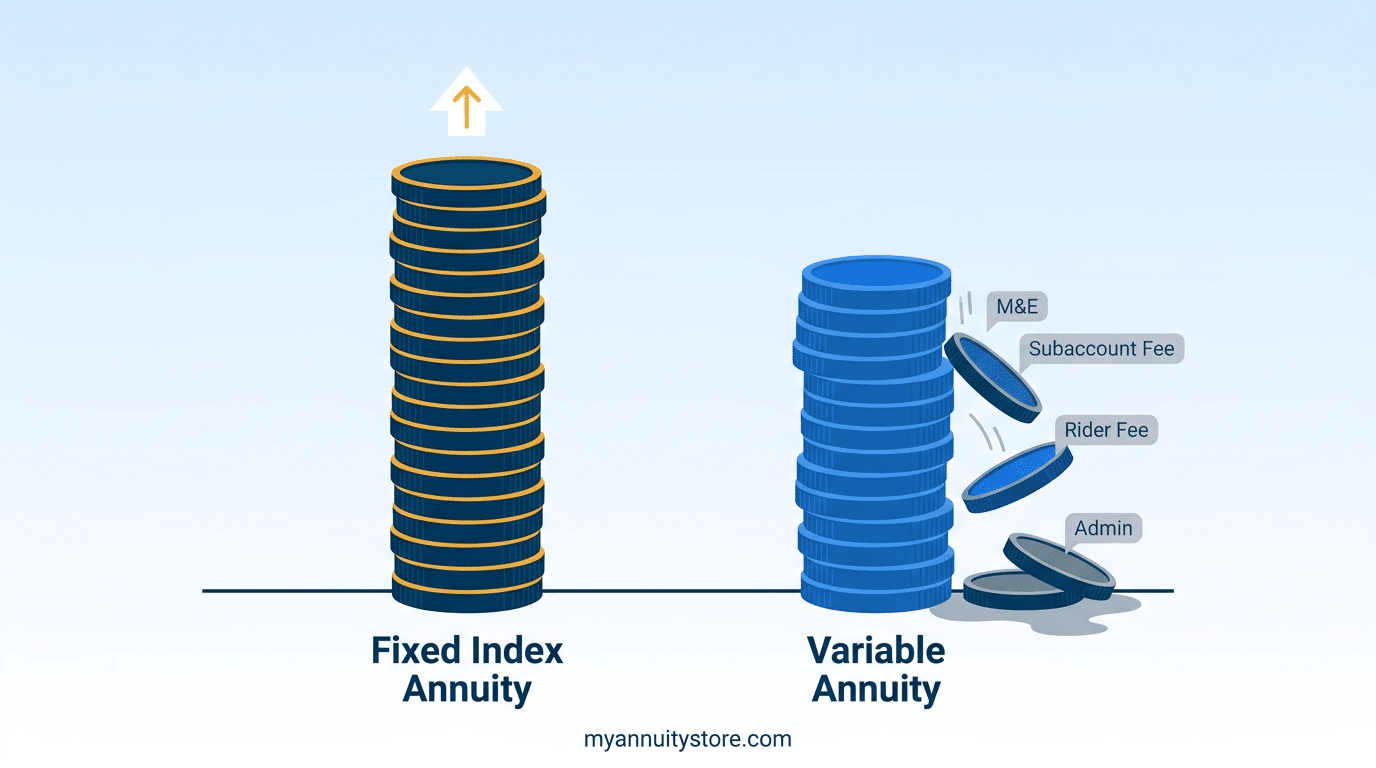
Fixed Index Annuity vs Mutual Fund: Which Is Better for Retirement?
The fixed index annuity vs mutual fund choice comes down to one trade: market upside or protection from loss. A mutual fund is a pooled investment that owns stocks, bonds, or both, and your money rises and falls with the market. A fixed index annuity (FIA) is an insurance contract that credits interest based on a market index while guaranteeing your principal will never decline due to a market drop.
- Mutual funds offer: higher long-term growth potential, full liquidity, and access to capital gains tax treatment.
- Fixed index annuities offer: principal protection, tax deferral, and the option to convert into a guaranteed lifetime income stream.
- The deciding factor: whether you need market upside or income certainty.
What Is a Mutual Fund?
A mutual fund is an investment company that pools money from many investors and uses it to buy a portfolio of stocks, bonds, or other securities. When you buy a share, you own a small slice of every holding in that portfolio. The fund is run by a portfolio manager (in actively managed funds) or follows a rules-based index (in index funds and ETFs).
Mutual funds are SEC-registered securities. They are offered through brokerage accounts, retirement plans, and directly from fund families like Vanguard, Fidelity, and Schwab.
- No guarantee: there is no insurance company involved and no contractual protection of any kind. If the underlying stocks fall 30%, your fund value falls roughly 30%.
- No cap on returns: in a strong market year, an S&P 500 index fund might return 25% or more. In a bad year, it might lose 25% or more.
- Long-run average: the U.S. stock market has historically returned about 10% a year before inflation, but that average hides huge year-to-year swings.
- Costs: you pay an annual expense ratio, from under 0.05% for low-cost index funds to over 1.50% for actively managed funds. There is no surrender period and no rider fee.
What Is a Fixed Index Annuity?
A fixed index annuity is an insurance contract that credits interest based on the performance of a market index, like the S&P 500. In a year when the index falls, your account value stays flat. In a year when the index rises, you earn a portion of that gain, capped at a number set by the carrier.
FIAs are insurance products regulated at the state level. You do not own the underlying index, and your money is not directly invested in stocks. The carrier uses options to credit you a portion of the index return based on a formula in your contract.
The trade-off is straightforward. You give up some upside (the cap or participation rate) in exchange for a hard floor of zero.
- Tax deferral: FIAs grow tax-deferred until you withdraw.
- Lifetime income: an FIA can be turned into guaranteed lifetime income through an income rider.
- Surrender charges: most contracts charge a fee if you withdraw more than 10% per year during the surrender period.
FIA vs Mutual Fund: Side-by-Side Comparison
| Feature | Fixed Index Annuity | Mutual Fund |
|---|---|---|
| Principal Protection | 100% protected from market loss | None; full market exposure |
| Growth Potential | Capped (typically 5% to 8% per year) | Unlimited; tracks market |
| Annual Fees | Typically zero (rider fees optional) | 0.05% to 1.50%+ expense ratio |
| Tax Treatment | Tax-deferred; ordinary income on withdrawal | Annual capital gains and dividends taxed yearly |
| Liquidity | 10% free withdrawal/year; surrender charges otherwise | Full liquidity; sell any business day |
| Lifetime Income Option | Yes, via income rider or annuitization | No; you have to manage withdrawals yourself |
| Sequence of Returns Risk | None; account value cannot fall | Significant; bad early returns can permanently damage retirement |
| Regulation | State insurance department | SEC registered |
| Best For | Income protection, late-career safety | Long-term growth, accumulation phase |
The Real Question: When Do You Need the Money?
The honest answer to “FIA or mutual fund” depends almost entirely on your time horizon. The longer you can leave the money alone, the more sense mutual funds make. The closer you are to needing the money for retirement income, the more sense an FIA makes.
- 25+ years away: even with terrible years mixed in, a long horizon gives compounding time to overwhelm volatility. A 35-year-old saving for retirement should generally pick mutual funds (or low-cost index ETFs) over an FIA.
- 5 to 10 years away: a single bad market year can cause permanent damage. If a $500,000 portfolio drops to $350,000 the year before you retire and you start drawing income from it, you may never recover.
That second risk is called sequence of returns risk, and it is the single biggest threat to retirees. An FIA removes it by design, because your account value cannot fall in a bad market year. You give up some upside in good years, but you don’t watch your nest egg get cut in half in a crash.
Worked Example: Two Buyers, Same $200,000
Here are two buyers with the same $200,000 starting amount. Both examples are hypothetical and assume steady average returns.
Scenario A: Tom, age 35, saving for retirement. Tom puts $200,000 into a low-cost S&P 500 index fund with a 0.05% expense ratio.
- Mutual fund at 10% a year for 30 years: about $3.4 million by age 65, before taxes.
- FIA at 5% a year for 30 years: about $864,000.
- Result: the mutual fund wins by more than $2.5 million.
Scenario B: Carol, age 62, retiring in 3 years. Carol puts $200,000 into the same S&P 500 index fund. Over the next 3 years, the market goes through a 35% bear market and recovers to where it started.
- Mutual fund: her ending balance is $200,000, but it dropped to $130,000 along the way and she panic-sold a portion at the bottom.
- FIA at 5% a year: about $231,525 after 3 years, with no drop along the way.
Tom should be in mutual funds. Carol should be in an FIA. The product is not the question; the time horizon and the buyer’s tolerance for loss are.
The Tax Treatment Is Different in Both Directions
Mutual funds and FIAs are taxed differently, and neither is clearly better for everyone.
- Mutual funds in a taxable account: you owe tax each year on dividends and on capital gains the fund distributes, whether or not you sold shares. When you sell, you owe capital gains tax on any appreciation. Long-term gains (held over 1 year) are taxed at 0%, 15%, or 20% depending on your income.
- FIAs (non-qualified): gains grow tax-deferred, and you owe nothing until you take a withdrawal. The gain is then taxed as ordinary income at your regular bracket (10% to 37%), which is usually higher than long-term capital gains rates.
- Inside an IRA: the treatment is identical. Both grow tax-deferred and both are taxed as ordinary income on withdrawal.
For long-term stock exposure in a taxable account, mutual funds usually win on taxes. The FIA’s tax deferral is worth more when the gains would have been taxed as ordinary income anyway, which is often the case for fixed income or for buyers in lower tax brackets. See how annuities are taxed for the details.
What About the Fees?
Mutual funds charge an annual expense ratio that comes out of fund returns each year:
- Index funds and ETFs: 0.03% to 0.20% annually
- Actively managed funds: 0.50% to 1.50% annually
- Funds-of-funds and target-date funds: 0.50% to 1.00% annually
FIAs typically charge zero annual fees on the base contract. The only fee is for an optional income rider, usually 0.75% to 1.25% per year, and only if you elect it.
That means a low-cost S&P 500 index fund and an FIA without a rider have similar fee profiles (essentially zero). Both are far cheaper than an actively managed mutual fund or a variable annuity. Fees are rarely where this decision gets made.
Who Should Choose a Fixed Index Annuity?
An FIA is the right choice if:
- You are within 10 years of retirement and want to protect part of your nest egg
- You cannot afford a major market loss given your time horizon
- You want guaranteed lifetime income without managing withdrawals yourself
- You would panic-sell in a crash and want to avoid market volatility
- You want to convert market gains from your working years into protected retirement income
If that sounds like you, compare current fixed index annuity rates to see today’s caps and participation rates.
Who Should Choose Mutual Funds?
Mutual funds are the right choice if:
- You have 15 or more years before you need the money
- You want unlimited upside and can stomach 30%+ drawdowns along the way
- You are still in the accumulation phase of your career
- You hold the funds in a tax-advantaged account (IRA, 401(k), HSA)
- You want full liquidity and the ability to rebalance freely
The Bottom Line
Mutual funds and fixed index annuities are not really competitors. They solve different problems at different stages of life. Mutual funds are the better tool for building wealth over decades, and FIAs are the better tool for protecting it as you move into retirement.
Many retirement plans use both. Mutual funds (or low-cost index ETFs) build the nest egg through your working years. As retirement gets close, a portion moves into an FIA to lock in gains, remove sequence of returns risk, and create a base of guaranteed lifetime income.
Want to figure out how much of your portfolio should move into an FIA before retirement? Request a free quote and analysis and we will run the numbers for your situation.
Related Reading
Mutual funds are one of several alternatives worth weighing. See the full set in our annuity comparison guides, or start with the fixed index annuity vs mutual fund basics above.
Frequently Asked Questions
Can I lose money in a mutual fund?
Yes. Mutual fund values rise and fall with the underlying market. In bear markets, broad stock funds can lose 30% to 50% of their value.
There is no insurance, no floor, and no guarantee of any kind. Bond funds are less volatile but can also lose money, especially when interest rates rise.
Can I lose money in a fixed index annuity?
Not from market losses. Your FIA account value cannot decline due to a drop in the underlying index. You can lose money only by surrendering early and paying a surrender charge, withdrawing more than the free withdrawal amount during the surrender period, or by paying optional rider fees that exceed your credited interest in a flat year.
Do mutual funds typically earn more than FIAs?
Over very long periods (20 to 30 years), yes, usually by a wide margin. The U.S. stock market has historically returned about 10% per year, while FIA crediting is limited by caps and participation rates, so long-run results tend to land closer to fixed annuities and bonds. Over shorter periods of 5 to 10 years, the picture is much less clear because mutual funds can have major losses while FIAs cannot.
Should I move my mutual funds into an FIA?
It depends on your age, your time horizon, and what role the money plays in your retirement plan. If you are 5 to 10 years from retirement and the mutual funds represent your primary retirement nest egg, moving a portion into an FIA can lock in gains and reduce sequence of returns risk. If you are still in your 30s or 40s, leaving the money in mutual funds usually makes more sense.
Can I hold mutual funds inside an FIA?
No. An FIA is an insurance contract, not a brokerage account. The carrier credits interest based on a market index, but you do not own any underlying shares.
If you want mutual fund-like investing inside an annuity wrapper, you are looking for a variable annuity instead. See our FIA vs variable annuity comparison for the trade-offs.
Is an FIA a good replacement for the bond portion of my portfolio?
Some retirees use an FIA in place of part of their bond holdings. The reasoning: FIAs offer better growth potential than bonds in flat markets, provide downside protection like high-quality bonds, and can be turned into guaranteed lifetime income via a rider. The trade-off is reduced liquidity compared to a bond fund.
If you decide an annuity belongs on the protected side of your portfolio, the next question is which kind. Our fixed annuity vs fixed index annuity comparison explains when a guaranteed rate beats index-linked crediting.