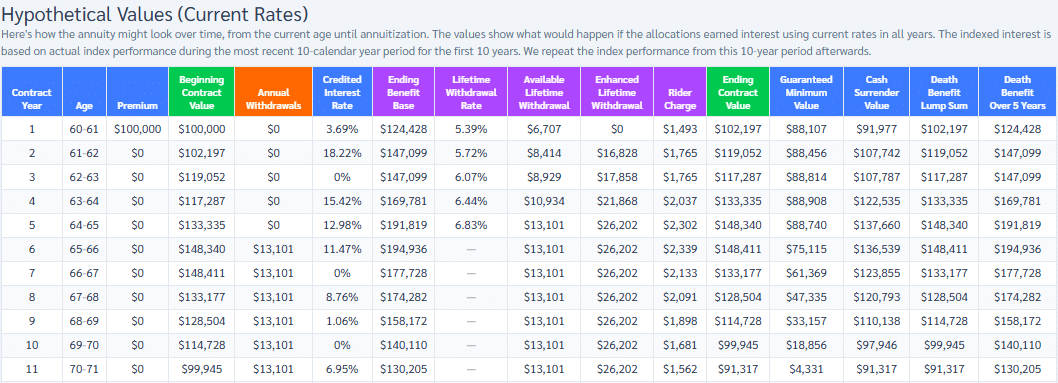
The NAC BenefitSolutions 10 is a fixed index annuity from North American Company for Life and Health Insurance, rated A+ by AM Best, that leads with a 20% income base bonus and a built-in rider that automatically builds your retirement income over time. Unlike many income annuities, NAC BenefitSolutions 10 doesn’t use a simple interest rollup. Instead, your income base mirrors your actual index credits (performance-driven rollup), starting with a 20% head start. This review breaks down every number from the March 2026 illustration and the official product brochure, including one important flag about the indexes backing this product that most agents won’t mention upfront.
What’s In This Review
- Quick Facts & AM Best Rating
- The 20% Income Base Bonus, How It’s Different From a Premium Bonus
- The Benefit Base Floor, Guaranteed Income Foundation
- Guaranteed Income by Start Year, Real Numbers
- Nursing Home Doubler & Death Benefit
- Surrender Schedule & Free Withdrawals
- Index Options, The Barclays Transitions Indexes
- Historical Performance: Worst, Best & Most Recent Periods
- ⚠️ Critical Flag: These Indexes Are 2 Years Old, All History Is Back-Tested
- Who Is the NAC BenefitSolutions 10 Best For?
- Pros and Cons
- Frequently Asked Questions
Quick Facts: NAC BenefitSolutions 10
Issued by North American Company for Life and Health Insurance, a subsidiary of Sammons Financial Group, the NAC BenefitSolutions 10 carries an A+ AM Best rating, the same top-tier grade as Allianz Life. North American has been issuing annuities for over a century and is a well-capitalized, established carrier.
| Issuer | North American Company for Life and Health Insurance |
|---|---|
| AM Best Rating | A+ (Superior) |
| Product Type | Fixed Index Annuity with Built-In Income Rider |
| Premium Bonus | None (on contract value) |
| Income Base Bonus | 20% applied to Benefit Base only |
| Surrender Period | 10 years |
| Free Withdrawal | 5% (year 2); 10% from year 3 onward (if no prior-year withdrawals) |
| Income Rider | Included, Guaranteed Benefits 10 Rider |
| Rider Rollup | Performance-driven: 100% of index credits applied to Benefit Base |
| Rider Fee | 1.20% annually on the Benefit Base |
| Issue Ages | 40–79 |
| Minimum Premium | $20,000 (qualified and non-qualified) |
| State Availability | Most states (not available in GU, NY, OR, PR, VI) |
The 20% Income Base Bonus, How It’s Different From a Premium Bonus
When agents pitch the NAC BenefitSolutions 10, the 20% bonus is usually the first thing mentioned. But this bonus works differently from a contract value bonus like Allianz’s 14% bonus. Here’s the critical distinction:
The 20% bonus applies to the Benefit Base only, not to the contract accumulation value. On a $100,000 deposit, your contract value starts at $100,000. Your Benefit Base, the number used to calculate income, starts at $120,000 (120% of your premium).
This is meaningful for income calculations. A higher benefit base means higher guaranteed income from day one. But if you surrender the contract early, you receive the contract accumulation value (minus any surrender charges), not the benefit base. The bonus only “pays off” through the income stream.
The Benefit Base Floor, Guaranteed Income Foundation
What makes the NAC BenefitSolutions 10 structurally distinct is its three-tier Benefit Base Floor. This is a contractually guaranteed minimum below which your benefit base cannot fall, regardless of index performance, unless you take withdrawals.
Benefit Base Floor by Contract Year
| Contract Years | Guaranteed Minimum Benefit Base | On $100,000 Premium |
|---|---|---|
| Years 1–5 | 120% of premium | $120,000 |
| Years 6–10 (5th anniversary step-up) | 150% of premium | $150,000 |
| Years 11+ (10th anniversary step-up) | 180% of premium | $180,000 |
Benefit base is reduced proportionally by any withdrawals taken, including RMDs.
The performance-driven rollup means your Benefit Base also grows by 100% of any index credits applied to your accumulation value. So in a strong year, the Benefit Base can grow faster than the floor guarantees. In flat or poor years, the Benefit Base Floor provides a guaranteed minimum foundation.
Guaranteed Income by Start Year, Real Numbers
For a 60-year-old male with $100,000 in a non-qualified account in Arizona, the guaranteed income amounts (based on the contractual Benefit Base Floor, not index performance) are:
Guaranteed Lifetime Income, $100,000 Premium, 60-Year-Old Male
| Start Income At | Age | Benefit Base (Floor) | Payout Factor | Annual Income | Monthly Income | Income/Premium Ratio |
|---|---|---|---|---|---|---|
| Year 1 (at issue) | 60 | $120,000 | 5.08% | $6,096 | $508 | 6.10% |
| Year 2 | 61 | $120,000 | 5.39% | $6,468 | $539 | 6.47% |
| Year 3 | 62 | $120,000 | 5.72% | $6,864 | $572 | 6.86% |
| Year 4 | 63 | $120,000 | 6.07% | $7,284 | $607 | 7.28% |
| Year 5 | 64 | $120,000 | 6.44% | $7,728 | $644 | 7.73% |
| Year 6 ← 5th Anniversary Step-Up | 65 | $150,000 | 6.83% | $10,245 | $854 | 10.25% |
| Year 7 | 66 | $150,000 | 7.25% | $10,875 | $906 | 10.88% |
| Year 8 | 67 | $150,000 | 7.47% | $11,205 | $934 | 11.21% |
| Year 9 | 68 | $150,000 | 7.69% | $11,535 | $961 | 11.54% |
| Year 10 | 69 | $150,000 | 7.93% | $11,895 | $991 | 11.90% |
| Year 11 ← 10th Anniversary Step-Up | 70 | $180,000 | 8.17% | $14,706 | $1,226 | 14.71% |
Income is guaranteed for life. Benefit base shown is the contractual floor, actual benefit base may be higher if index credits applied. Single life payout for male, 60 at issue. Joint life payouts are lower. Payout factors and benefit base floors are as of March 2026 and subject to change at issue.
Notice the significant jump at year 6 (age 65) when the benefit base steps up from $120,000 to $150,000. A buyer who starts income at 64 vs. 65 sees a $2,517/year difference in guaranteed income. Waiting the extra year pays off significantly here.
Similarly, the year 11 (age 70) step-up to $180,000 boosts annual income from $11,895 (year 10) to $14,706, a $2,811/year increase for waiting just one more year. If index performance has been strong, the actual benefit base may be even higher than $180,000, further increasing income.
Nursing Home Doubler & Enhanced Death Benefit
Nursing Home Doubler
If a covered person is confined to a nursing home for 90 consecutive days and remains in the nursing home when each annual payment is due, North American doubles the Lifetime Payment Amount. This benefit becomes available on the second contract anniversary and applies as long as the accumulation value is not zero.
Enhanced Death Benefit
The NAC BenefitSolutions 10 offers beneficiaries a choice between two options at death:
- Lump sum: The accumulation value (or premium if no withdrawals taken and accumulation value is less than premium)
- Rider death benefit: The full Benefit Base paid out over 5 equal annual payments (available in most states after the first contract year)
The rider death benefit option is significant: if the benefit base is $150,000 and the contract value is $120,000, beneficiaries can elect the benefit base paid in five annual installments, a better outcome than the lump-sum contract value.
Surrender Schedule & Free Withdrawals
The NAC BenefitSolutions 10 has the steepest surrender schedule of the three products reviewed here. Year 1 and Year 2 both charge 10%, meaning an early exit in the first two years results in a 10% charge on the excess amount withdrawn, plus an MVA.
Surrender Charge Schedule (Most States)
| Contract Year | 1 | 2 | 3 | 4 | 5 | 6 | 7 | 8 | 9 | 10 | 11+ |
|---|---|---|---|---|---|---|---|---|---|---|---|
| Surrender Charge | 10% | 10% | 9% | 9% | 8% | 8% | 7% | 6% | 4% | 2% | 0% |
California and several other states have different surrender schedules. Consult your advisor for your state’s specific terms.
Free Withdrawal Rules, Important: Year 2 vs. Year 3+
The free withdrawal provision is more restrictive than typical FIAs:
- Year 2: 5% of accumulation value penalty-free
- Year 3+: 10% of accumulation value penalty-free, but only if no withdrawals were taken in the prior year
This means if you take even a small withdrawal in year 2, your year 3 free withdrawal is limited to 5% (not 10%). And the 1.20% rider charge does NOT count as a withdrawal against this limit, it’s automatically deducted from accumulation value on each contract anniversary.
Index Options, The Barclays Transitions Indexes
Unlike the IncomeShield 10 (which uses familiar S&P 500-linked strategies) or the Allianz Accumulation Advantage+ (which uses Allianz’s own Blended Futures Index), the NAC BenefitSolutions 10 is built entirely around Barclays Transitions indexes, four variants of two proprietary indexes, offered in 1-year and 2-year crediting periods:
| Index Strategy | Crediting Period | Current Participation Rate | Inception Date |
|---|---|---|---|
| Barclays Transitions 12 VC | 2-Year PTP | 70% | March 31, 2023 |
| Barclays Transitions 6 VC | 2-Year PTP | 140% | March 31, 2023 |
| Barclays Transitions 12 VC | 1-Year PTP | 45% | March 31, 2023 |
| Barclays Transitions 6 VC | 1-Year PTP | 90% | March 31, 2023 |
The “12 VC” and “6 VC” designations refer to volatility targets. The 12 VC index targets higher volatility (and thus higher potential returns), while the 6 VC targets lower volatility. Both are Barclays-designed indexes that blend equities, bonds, and cash based on a proprietary model.
Historical Performance: Worst, Best & Most Recent 10-Year Periods
Before reading these numbers, read the critical flag below. All historical data for these indexes is back-tested.
2-Year Barclays Transitions 12 VC (70% Participation), $25,000 Allocation
| Scenario | Period | Annualized Credited Rate | Value After 10 Years |
|---|---|---|---|
| Best Period | 2012–2021 | 12.64% | $70,374 |
| Worst Period | 2006–2015 | 7.13% | $42,286 |
| Most Recent | 2016–2025 | 8.83% | $49,889 |
2-Year Barclays Transitions 6 VC (140% Participation), $25,000 Allocation
| Scenario | Period | Annualized Credited Rate | Value After 10 Years |
|---|---|---|---|
| Best Period | 2012–2021 | 11.70% | $64,712 |
| Worst Period | 2007–2016 | 6.68% | $40,807 |
| Most Recent | 2016–2025 | 8.05% | $46,435 |
1-Year Barclays Transitions 12 VC (45% Participation), $25,000 Allocation
| Scenario | Period | Annualized Credited Rate | Value After 10 Years |
|---|---|---|---|
| Best Period | 2012–2021 | 8.73% | $49,443 |
| Worst Period | 2007–2016 | 5.36% | $36,058 |
| Most Recent | 2016–2025 | 6.95% | $41,911 |
1-Year Barclays Transitions 6 VC (90% Participation), $25,000 Allocation
| Scenario | Period | Annualized Credited Rate | Value After 10 Years |
|---|---|---|---|
| Best Period | 2012–2021 | 8.24% | $47,226 |
| Worst Period | 2007–2016 | 5.12% | $35,249 |
| Most Recent | 2016–2025 | 6.55% | $40,373 |
Overall Illustration Result
Using the most recent 10-year period as the baseline (income starting at age 65), the illustration projects:
- $13,007/year in guaranteed lifetime income beginning at age 65
- $403,205 in cumulative withdrawals over the life of the contract
- 7.6% annual effective rate of return
⚠️ Critical Flag: These Indexes Are 2 Years Old, All History Is Back-Tested
🚨 The Most Important Thing to Know About the NAC BenefitSolutions 10
The Barclays Transitions 12 VC and Barclays Transitions 6 VC indexes both launched on March 31, 2023. As of March 2026, these indexes have only 2 years of real, live performance data.
Every “historical” table in the illustration, the 2006–2015 worst period, the 2012–2021 best period, all of it, is 100% back-tested, simulated data. Barclays used their model to calculate what the index would have done if it had existed. This is a standard industry practice, but it carries serious limitations.
Why Back-Testing Overstates Future Performance
- Back-tests are optimized: Indexes are designed after the fact using historical data. The model is calibrated to perform well against the past it’s being tested on.
- Back-tested results don’t reflect real costs: Transaction costs, rebalancing friction, and index maintenance fees are often understated or excluded in simulated histories.
- The live performance confirms the concern: In the “most recent” 2-year period data (2023–2025), the 2-year strategies show $0 in credits for the last three years. The 1-year strategies earned only 8.76% and 8.57% in 2023, then dropped to under 1.06% in 2024 and 0% in 2025. The live performance does not match the back-tested projections.
The “Most Recent” Period Includes Only Back-Tested Data
The illustration uses 2016–2025 as its “most recent” 10-year period, but these indexes didn’t exist until 2023. Even the “most recent” scenario is primarily back-tested history, not real index returns.
What This Means for the Illustrated 7.6% Return
The 7.6% annual effective rate of return in the illustration assumes the back-tested historical patterns repeat. Given that live performance for the 2-year strategies has been flat to zero for the past 3 years, buyers who purchased this product in 2023–2024 may have seen very different results than the illustration suggests.
Bottom line: The NAC BenefitSolutions 10’s income guarantees are real and contractually binding, the income you see in the guarantee tables above will be paid for life. But the illustration’s projected accumulation values and effective returns depend heavily on indexes with limited real-world track records that have underperformed their back-tested history since launch.
Who Is the NAC BenefitSolutions 10 Best For?
Despite the index concerns above, the NAC BenefitSolutions 10 has genuine strengths, particularly for buyers who prioritize the guaranteed income mechanics over accumulation potential.
The product makes the most sense if you:
- Are buying for the guaranteed income floor and the Benefit Base step-ups at years 5 and 10, not for index performance
- Plan to hold through the full 10-year surrender period and start income at or after year 6 (when the step-up to $150,000 benefit base applies)
- Value the nursing home doubler as a care-cost hedge
- Want the rider death benefit option, where beneficiaries can receive the higher benefit base (not just the contract value) paid over 5 years
- Are working with a $100,000–$250,000 premium and want $10,000–$15,000/year in guaranteed income starting around age 65–70
Be cautious if you:
- Are primarily buying for accumulation, the back-tested index performance is not a reliable predictor of future returns
- Need the 10% annual free withdrawal starting in year 1, this product limits year 2 free withdrawals to 5%
- Live in Oregon (not available)
- Expect to surrender early, the 10%/10% double charge in years 1–2 is the harshest surrender schedule of the three products in this review
Pros and Cons
✅ Pros
- A+ AM Best rating, top-tier financial strength from Sammons Financial Group
- 20% income base bonus immediately increases the benefit base to $120,000 on $100,000 in
- Contractual benefit base step-ups at years 5 and 10, guaranteed income floor that doesn’t depend on markets
- Performance-driven rollup: strong index years further boost the benefit base above the guaranteed floor
- Nursing home doubler, income doubles if confined to nursing home for 90+ days
- Enhanced death benefit: beneficiaries can choose benefit base (paid over 5 years) instead of contract value
- Competitive income payouts, $10,245/year at age 65 and $14,706 at age 70 on $100,000
- Cumulative projected withdrawals of $403,205 on $100,000 is among the strongest of income-focused FIAs
⚠️ Cons
- All index options launched March 2023, only 2 years of live performance data; all historical charts are back-tested
- Live 2-year strategy performance has been flat to zero for 2023–2025, not matching the back-tested projections
- Highest surrender charges of the three reviewed products: 10% in years 1 and 2
- Free withdrawal in year 2 is only 5% (not 10%), and the 10% only applies in year 3+ if no prior-year withdrawals taken
- 1.20% rider fee charged on benefit base, as benefit base grows, so does the fee’s dollar impact
- Not available in Oregon or New York
- Maximum issue age is 79, slightly more restrictive than competitors
Want to Compare NAC BenefitSolutions 10 to Other Income Annuities?
The best income annuity depends on your age, deposit amount, when you need income, and how you feel about the index assumptions. We can run side-by-side illustrations of this and competing products so you can compare guaranteed income on your terms.
📄 Download the Official Product Brochure
Review the complete product details directly from the carrier. The official brochure includes all current rates, allocation options, and state-specific variations.
Frequently Asked Questions
What is the NAC BenefitSolutions 10 income base bonus?
The 20% income base bonus applies to the Benefit Base, not the contract accumulation value. On a $100,000 deposit, the Benefit Base starts at $120,000 immediately, giving you a head start on guaranteed income calculations. The contract value itself starts at $100,000. The bonus only pays off through the income you receive over time, it cannot be accessed as a lump sum.
How does the NAC BenefitSolutions 10 income rider work?
The Guaranteed Benefits 10 Rider uses a “performance-driven rollup”, meaning your Benefit Base grows by 100% of whatever index credits your contract earns. It also has a contractual floor: 120% of premium in years 1–5, 150% in years 6–10, and 180% in year 11+. When you’re ready for income, North American multiplies your Benefit Base by a payout factor based on your age and deferral years. Payments are guaranteed for life, regardless of how long you live.
Are the NAC BenefitSolutions 10 index performance numbers real?
No, the Barclays Transitions 12 VC and Barclays Transitions 6 VC indexes launched on March 31, 2023. All historical performance data shown in illustrations covering years before 2023 is back-tested (simulated). Only the most recent 2 years of data reflects actual live index performance. The guaranteed income amounts in the contract are real and binding, but the illustrated accumulation values depend on index performance that has only been proven for 2 years in a live environment.
What is the nursing home benefit on the NAC BenefitSolutions 10?
If a covered person is confined to a nursing home for 90 consecutive days and remains there when the annual payment is due, the Lifetime Payment Amount doubles. This benefit becomes available on the second contract anniversary and is only available while the accumulation value is greater than zero. Unlike the American Equity Wellbeing Benefit, this specifically requires nursing home confinement, not just the inability to perform ADLs.
How does the NAC BenefitSolutions 10 compare to the American Equity IncomeShield 10?
Both are income-focused FIAs with 10-year surrender periods and 1.20% rider fees. The key differences: NAC offers a 20% income base bonus and contractual step-up floors at years 5 and 10, while American Equity offers a 10% simple interest rollup that’s independent of market performance. NAC’s indexes are all back-tested with only 2 years of real data; American Equity uses S&P 500-linked strategies with decades of real history. For pure guaranteed income mechanics, NAC’s step-up structure can produce higher income at the 5- and 10-year marks. For accumulation confidence and index track records, American Equity has a meaningful advantage.