How Much Does a $200,000 Annuity Pay Per Month?
A $200,000 annuity can pay between $900 and $1,400 per month if you purchase a Single Premium Immediate Annuity (SPIA), depending on your age, gender, and payout structure. Younger buyers receive less per month because the insurance company expects to make payments over a longer period. Older buyers get more.
But a SPIA is not the only option. You could also place $200,000 into a MYGA for guaranteed interest income, or a fixed index annuity with an income rider for lifetime withdrawal benefits. Each approach delivers a different monthly number, and the right choice depends on your goals, timeline, and tax situation.
This guide compares realistic 2026 payouts across all three annuity types so you can see exactly what $200,000 produces at every age.
$200,000 SPIA Monthly Payouts by Age
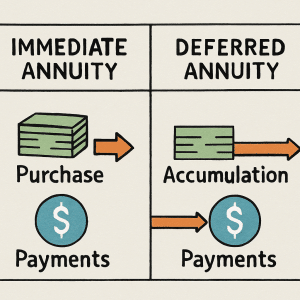
A Single Premium Immediate Annuity (SPIA) converts your $200,000 into guaranteed monthly income starting within 30 days. Payouts are calculated using your age, current interest rates, and the payout option you choose.
The table below shows approximate 2026 monthly payouts for a $200,000 SPIA under three common structures: single life (payments stop at your death), joint life (payments continue until both spouses die), and 10-year period certain (payments guaranteed for at least 10 years, even if you die sooner).
| Age at Purchase | Single Life (Monthly) | Joint Life (Monthly) | 10-Year Period Certain (Monthly) |
|---|---|---|---|
| 55 | $1,020 | $890 | $985 |
| 60 | $1,110 | $965 | $1,060 |
| 65 | $1,230 | $1,055 | $1,150 |
| 70 | $1,400 | $1,180 | $1,280 |
| 75 | $1,640 | $1,350 | $1,440 |
At age 65, a single life SPIA on $200,000 pays roughly $1,230 per month. Joint life drops to about $1,055 because the insurer must pay until the second spouse passes away. The 10-year period certain option falls between the two, offering a minimum payment guarantee in exchange for slightly lower monthly income than a pure single life payout.
Use our immediate annuity calculator to get a personalized estimate based on your exact age, state, and preferred payout structure.
How Much Does a $200,000 MYGA Pay?
A Multi-Year Guaranteed Annuity (MYGA) does not convert your money into a lifetime income stream. Instead, it locks in a fixed interest rate for a set term, similar to a bank CD but typically with better rates and tax-deferred growth.
With $200,000 in a 5-year MYGA paying 5.00%, you earn $10,000 per year, or approximately $833 per month in interest income. If you let the interest compound instead of withdrawing it, your $200,000 grows to roughly $255,300 after five years.
Here is what $200,000 earns at various MYGA terms and rates available in 2026:
| MYGA Term | Rate | Annual Interest | Monthly Interest | Value at End of Term |
|---|---|---|---|---|
| 3-Year | 4.75% | $9,500 | $792 | $229,900 |
| 5-Year | 5.00% | $10,000 | $833 | $255,300 |
| 7-Year | 5.15% | $10,300 | $858 | $284,200 |
| 10-Year | 5.25% | $10,500 | $875 | $332,700 |
The key difference between a MYGA and a SPIA is control. With a MYGA, you keep your principal. At the end of the term, you can renew, cash out, or roll the funds into a SPIA for lifetime income. With a SPIA, you trade your $200,000 for a guaranteed paycheck, but you cannot get the lump sum back.
Check today’s top MYGA rates on our fixed annuity rates page to see which carriers are offering the best returns.
$200,000 Fixed Index Annuity with Income Rider
A fixed index annuity (FIA) with an income rider takes a different approach. You deposit $200,000, let it grow for several years through index-linked interest credits, and then activate a guaranteed lifetime withdrawal benefit (GLWB) when you are ready for income.
Here is a realistic example. You purchase an FIA at age 60 with a $200,000 premium. The income rider has a guaranteed rollup rate of 7% simple interest on the benefit base. You defer for 7 years and activate income at age 67.
- Starting benefit base: $200,000
- Benefit base after 7 years (7% simple rollup): $298,000
- Withdrawal rate at age 67: 5.25%
- Annual guaranteed income: $15,645
- Monthly guaranteed income: approximately $1,304
This income is guaranteed for life, even if your account value drops to zero. The actual account value may also grow separately through index credits, providing an additional legacy benefit. However, the rider fee (typically 0.95% to 1.20% of the benefit base annually) is deducted from your account value each year.
FIA income riders work best when you can defer for at least 5 to 10 years before turning on the income. If you need money right away, a SPIA is the simpler choice.
What Factors Affect Your $200,000 Annuity Payout?
Six primary factors determine how much monthly income your $200,000 generates:
Your age at purchase. Older buyers receive higher monthly payouts because the insurance company expects to make fewer payments. A 75-year-old gets roughly 60% more per month from a SPIA than a 55-year-old with the same $200,000.
Gender. Women typically receive slightly lower SPIA payouts than men at the same age because women have longer average life expectancies. The difference is usually 3% to 6%.
Annuity type. A SPIA provides the highest immediate monthly income because you are giving up access to your principal. A MYGA preserves your principal but pays only interest. An FIA with income rider falls somewhere in between, offering lifetime income with some account value remaining.
Current interest rates. Annuity payouts rise and fall with prevailing interest rates. When the Federal Reserve raises rates, insurance companies can invest your premium at higher yields, which translates into better payouts for you. The 2025-2026 rate environment has been favorable for annuity buyers compared to the previous decade.
Single vs. joint life. Joint life payouts are 10% to 20% lower than single life because the insurer covers two lives instead of one. If your spouse depends on the income, joint life is worth the reduction.
Period certain guarantees. Adding a 10-year or 20-year period certain guarantee reduces your monthly payout slightly in exchange for ensuring that payments continue to a beneficiary if you die early. A 10-year period certain typically reduces income by 3% to 7% compared to a pure life-only payout.
Tax Considerations for a $200,000 Annuity
How your annuity income is taxed depends on whether you funded it with pre-tax or after-tax money.
Qualified annuity (funded with IRA or 401(k) money): Every dollar of your monthly payout is taxed as ordinary income. If you receive $1,230 per month from a qualified SPIA, all $14,760 per year is added to your taxable income. This is because you have never paid taxes on the original $200,000.
Non-qualified annuity (funded with after-tax savings): Only the earnings portion of each payment is taxable. The IRS uses something called the exclusion ratio to determine how much of each payment represents a return of your original $200,000 (tax-free) versus interest or gain (taxable).
For example, if a 65-year-old purchases a non-qualified SPIA with $200,000 and has a life expectancy of 20 years, the exclusion ratio would make roughly 55% to 60% of each payment tax-free during those years. On a $1,230 monthly payment, approximately $680 to $740 would be excluded from taxes each month. The IRS provides detailed guidance on annuity taxation in Publication 575.
For MYGAs, the interest grows tax-deferred. You only owe taxes when you withdraw the gains, not while the money is sitting in the contract. This is one reason MYGAs are popular with people who want to delay income into lower-earning retirement years.
Real Example: Robert and Patricia, Age 65 and 63
Robert, age 65, has $200,000 in an old 401(k) that he wants to convert into retirement income. He is considering his options.
Option A: SPIA, single life. Robert purchases a SPIA and receives $1,180 per month for life. If Robert dies after 8 years, the payments stop and Patricia receives nothing from the annuity.
Option B: SPIA, joint life with Patricia (age 63). Robert and Patricia purchase a joint life SPIA and receive $1,020 per month. Payments continue at the full $1,020 until the second spouse passes away. This gives Patricia income security, but the monthly check is $160 less.
Option C: Split strategy. Robert puts $120,000 into a joint life SPIA for $612 per month in guaranteed income, and $80,000 into a 5-year MYGA at 5.00% to preserve some liquidity. The MYGA earns $4,000 per year ($333/month) in interest he can withdraw if needed, while keeping the $80,000 principal intact for emergencies or a future annuity purchase at older ages when rates are higher.
Robert and Patricia chose Option C. The combination of guaranteed income plus accessible savings gave them the confidence to retire without worrying about outliving their money or being locked into a single product.
How to Maximize Your $200,000 Annuity
Compare quotes from multiple carriers. Annuity rates vary significantly between insurance companies. The same $200,000 SPIA can pay $50 to $100 more per month depending on which carrier you choose. Request a free quote comparison to see current offers.
Consider your timing. If you are 60 and do not need income until 67, deferring for 7 years with an FIA income rider or a MYGA ladder can significantly increase your eventual monthly payout. Every year you defer a SPIA purchase, your age-based payout rate increases.
Match the product to the need. Use a SPIA for guaranteed income you cannot outlive. Use a MYGA if you want to preserve principal and earn a competitive fixed rate. Use an FIA with an income rider if you want lifetime income with some growth potential and flexibility.
Do not put all $200,000 in one product. Splitting across two or three annuity types provides both guaranteed income and liquidity. You avoid the all-or-nothing feeling that makes some buyers hesitate.
Check your state’s guaranty association limits. Most states protect annuity contracts up to $250,000 per carrier through the state guaranty association. Your $200,000 falls within this limit at a single carrier, but if you add other annuity holdings, consider spreading across carriers.
According to LIMRA, total U.S. annuity sales reached $432 billion in 2024, with fixed annuities driving the majority of growth. The strong rate environment has made 2025 and 2026 especially favorable years for annuity buyers.
If you already know what a $100,000 annuity pays, doubling that investment does not simply double the monthly income in every case, but it comes close for most SPIA and MYGA products. The real advantage of a larger premium is flexibility: you have enough to split across multiple strategies and build a more resilient income plan.
Frequently Asked Questions
Can I get $200,000 back after buying a SPIA?
No. A SPIA is an irrevocable exchange of your lump sum for guaranteed lifetime income. Once you purchase it, you cannot withdraw the $200,000 as a lump sum. That is why many people use only a portion of their savings for a SPIA and keep the rest in accessible accounts like MYGAs or other investments.
What is the best annuity type for $200,000 if I need income immediately?
A SPIA provides the highest guaranteed monthly income starting within 30 days. At age 65, you can expect roughly $1,230 per month from a single life SPIA. If you want to preserve your principal, a MYGA paying 5.00% generates about $833 per month in interest, but that is interest only, not a lifetime income guarantee.
How does inflation affect a $200,000 annuity?
Most fixed annuities, including SPIAs and MYGAs, do not adjust for inflation. If inflation runs at 3% per year, the purchasing power of your $1,230 monthly SPIA payment declines over time. Some carriers offer inflation-adjusted SPIAs, but the starting payout is 20% to 30% lower. An alternative is to ladder annuity purchases over several years so that newer contracts reflect updated rates.
Should I use IRA money or savings for a $200,000 annuity?
Using after-tax savings (non-qualified money) for a SPIA gives you a tax advantage through the exclusion ratio, which makes a portion of each payment tax-free. If you use IRA or 401(k) money (qualified), every dollar of the payout is fully taxable as ordinary income. The best choice depends on your overall tax picture, including your other income sources and tax bracket.
Is $200,000 enough to retire on with an annuity?
By itself, probably not. A $200,000 SPIA at age 65 pays around $1,230 per month. Combined with the average Social Security benefit of $1,907 per month (according to the Social Security Administration), that gives you about $3,137 per month in guaranteed income. Whether that covers your expenses depends on where you live, your health care costs, and your lifestyle. Most financial planners suggest $200,000 is a strong piece of a retirement income plan rather than the entire plan.