Last updated: April 1, 2026
When Should I Claim Social Security? Age 62 vs. 67 vs. 70 Compared
Claiming Social Security at 62 locks in a permanent reduction – as low as 70% of your full benefit if you were born in 1960 or later. Waiting until 70 boosts that same benefit to 124%. The gap between those two choices can easily exceed $100,000 over a 20-year retirement.
This guide walks through every claiming age, shows you real dollar comparisons, and helps you decide which option fits your health, income, and household situation.
What Is Your Full Retirement Age (FRA)?
Your Full Retirement Age is the age at which you receive 100% of your earned Social Security benefit. For anyone born in 1960 or later, FRA is 67.
If you were born between 1943 and 1959, your FRA falls somewhere between 66 and 67. Use the Full Retirement Age chart to confirm your exact age before making any decisions.
FRA is the anchor point for every calculation in this article. Everything else – early reductions and delayed credits – is measured against it.
How Much Is the Reduction for Claiming at 62?
For anyone born in 1960 or later, claiming at 62 reduces your monthly benefit by 30%, leaving you with 70% of your FRA amount. That reduction is permanent and applies to every check you receive for the rest of your life.
The SSA breaks it down this way: benefits are reduced 5/9 of 1% per month for the first 36 months before FRA, then 5/12 of 1% per month beyond that. You can review the exact math in the SSA early retirement reduction table.
On a $2,000 FRA benefit, that 30% cut means $600 gone from every monthly check – permanently.
What Happens If You Wait Until 70?
Delaying past FRA earns you delayed retirement credits of 8% per year, compounding until age 70. By 70, your benefit reaches 124% of the FRA amount.
The SSA explains the full credit schedule in their SSA delayed retirement credits page. There is no additional increase for waiting past 70, so that is the ceiling.
On a $2,000 FRA benefit, waiting to 70 produces $2,480 per month. That is $480 more every single month compared to claiming at FRA, and $1,080 more per month compared to claiming at 62.
Claiming Age Comparison Table
The table below uses a $2,000 FRA monthly benefit (born 1960, FRA = 67) to show how each claiming age affects your monthly income and when you break even versus claiming at FRA.
| Claiming Age | % of FRA Benefit | Monthly Benefit | Break-Even vs. FRA | Best For |
|---|---|---|---|---|
| 62 | 70% | $1,400 | ~Age 77-78 | Poor health, needs income now, lower earner in a couple |
| 63 | 75% | $1,500 | ~Age 78 | Early retirees with some other income |
| 64 | 80% | $1,600 | ~Age 78-79 | Moderate health, partial retirement |
| 65 | 86.7% | $1,733 | ~Age 79 | Medicare eligibility year – often a natural inflection point |
| 66 | 93.3% | $1,867 | ~Age 80 | Good health, bridge income available |
| 67 (FRA) | 100% | $2,000 | N/A (baseline) | Average health, wants simplicity |
| 68 | 108% | $2,160 | ~Age 81 | Good health, partial work income |
| 69 | 116% | $2,320 | ~Age 82 | Excellent health, strong savings |
| 70 | 124% | $2,480 | ~Age 82-83 | Long family history, higher earner in a couple |
Break-even ages are approximations based on cumulative lifetime payments. For a personalized calculation, visit our Social Security break-even age tool.
What Are the Pros and Cons of Claiming at 62?
Claiming at 62 puts money in your pocket immediately, but you give up 30% of your benefit permanently. For some retirees, that trade-off makes sense.
Reasons claiming at 62 makes sense:
- You have a serious health condition and a shorter life expectancy
- You have no other retirement income and need cash flow now
- You are the lower-earning spouse in a married couple (more on this below)
- You plan to invest the early payments in income-producing assets
- You lost your job and have no other bridge income
Reasons to think twice:
- If you live past your mid-to-late 70s, you will collect less in lifetime benefits than if you waited
- Your benefit forms the base for any survivor benefit your spouse receives – a lower benefit affects them too
- If you continue working after claiming at 62, the earnings test can temporarily withhold benefits until you reach FRA
Read more about the trade-offs in our full guide on taking Social Security at 62.
Should You Claim at Full Retirement Age?
Claiming at FRA (67 for those born in 1960+) gives you 100% of your earned benefit with no reductions and no delayed credit calculation needed. It is the simplest choice and often the right one for people in average health.
FRA claiming avoids the earnings test entirely. If you are still working part-time or consulting, there is no benefit withholding once you have hit FRA. That flexibility matters for people who retire gradually rather than all at once.
The downside is that you leave up to 24% more monthly income on the table versus waiting to 70. For a $2,000 FRA benefit, that is $480 per month – or $5,760 per year – given up permanently.
Is Waiting Until 70 Always the Best Strategy?
Waiting to 70 maximizes your monthly check but requires you to fund roughly three years of living expenses without Social Security income. Whether that math works depends on your health, savings, and household situation.
The 8% annual delayed credit is one of the best guaranteed returns available anywhere. No stock, CD, or annuity offers a risk-free, inflation-adjusted 8% annual return on a lifetime income stream. For anyone in good health with savings to bridge the gap, delaying to 70 is often the highest-value financial decision in retirement planning.
But it only pays off if you live long enough to reach the break-even point – typically around age 82 to 83 versus claiming at FRA. Review life expectancy by age data to estimate whether your timeline supports the delay.
What Is the Break-Even Age and Why Does It Matter?
The break-even age is the point at which total lifetime payments from the later claiming date surpass total lifetime payments from the earlier date. If you live past that age, waiting was the right call. If you die before it, claiming earlier would have paid out more.
Here is a concrete example. Thomas, age 62, has a projected FRA benefit of $2,000 per month. He is deciding between claiming now at $1,400 or waiting until 70 at $2,480.
- From 62 to 70 (8 years), Thomas collects $134,400 by claiming early ($1,400 x 96 months)
- After 70, the delay option pays $1,080 more per month than the early option
- $134,400 divided by $1,080 = approximately 124 months, or about 10.3 years
- Break-even age: roughly 80 years old
If Thomas lives to 85 or 90, waiting was worth it. If he passes at 76, claiming early would have yielded more total income. There is no universally correct answer – only the answer that fits your specific life expectancy and financial situation.
The SSA’s own publication, SSA publication: When to Start Receiving Retirement Benefits, walks through this longevity framework in plain language.
How Should Married Couples Coordinate Social Security Claims?
For married couples, the optimal strategy almost always involves the higher earner delaying to 70 while the lower earner claims early. This approach maximizes the household’s lifetime income and protects the surviving spouse.
Here is why the survivor benefit makes this so important. When one spouse dies, the surviving spouse keeps the larger of the two benefit amounts. If the higher earner claimed early and took a 30% reduction, that reduced amount becomes the survivor’s income for the rest of their life. Delaying the higher earner’s benefit directly protects the surviving spouse’s financial security for potentially decades.
Review the full details of spousal benefit rules before finalizing any household strategy.
Real Example: Robert and Linda, Both Born in 1960
Robert’s projected FRA benefit: $2,800/month. Linda’s projected FRA benefit: $1,400/month. Both are 62 and considering retirement.
Option A – Both claim at 62:
Robert: $1,960/month (70% of $2,800). Linda: $980/month (70% of $1,400). Combined: $2,940/month.
Option B – Linda claims at 62, Robert waits to 70:
From age 62 to 70, Linda collects $980/month while Robert uses savings or other income. At 70, Robert’s benefit becomes $3,472/month (124% of $2,800). Combined from age 70: $4,452/month.
The difference: Once Robert hits 70, Option B generates $1,512 more per month. Over 15 years of combined retirement, that gap compounds to well over $270,000 in additional lifetime income – plus a much larger survivor benefit if Robert dies first.
Option B does require Robert to have bridge income from ages 67 to 70. This is exactly where an annuity bridge strategy can replace Social Security income during the delay period, allowing a retiree to defer claiming without drawing down investment accounts.
What Is the Annuity Bridge Strategy?
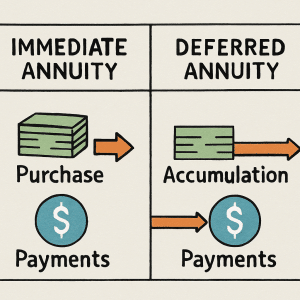
An annuity bridge strategy uses a short-term fixed annuity or immediate annuity to replicate the Social Security income you would receive if you claimed early – so you can delay claiming without running out of cash. The annuity pays out during the gap years (say, 62 to 70), and then Social Security kicks in at its maximized amount.
This approach works especially well for retirees who have $200,000 or more in savings and are in good health. Rather than claiming a permanently reduced Social Security benefit, they bridge the income gap with annuity payments and then collect a much larger guaranteed income stream for life at 70.
For a full breakdown of how to structure this, see our guide on the annuity bridge strategy.
What If You Are Still Working When You Claim?
If you claim before FRA and continue working, the Social Security earnings test can temporarily reduce your benefit. In 2026, SSA withholds $1 for every $2 you earn above $22,320 per year (the annual exempt amount).
This is not a permanent loss. Withheld benefits are recalculated and added back once you reach FRA. But the cash flow interruption surprises many retirees who did not plan for it. If you plan to keep working, waiting until at least FRA to claim is almost always cleaner.
At FRA and beyond, there is no earnings test. You can collect full Social Security benefits and earn as much as you want from work with no reduction.
How Do You Make the Final Decision?
Three factors drive the optimal claiming age for most retirees: health and life expectancy, current income needs, and whether you are married. Run the numbers for your own situation before making any irreversible decision.
- Health is poor or life expectancy is short: Claiming early, typically at 62 to 65, often produces better lifetime results
- Health is good, savings are adequate: Delaying to 70 is usually the highest-value choice
- You are married and the higher earner: Delay to 70 to maximize the survivor benefit
- You are married and the lower earner: Consider claiming early while your spouse delays
- You need income now and have no other assets: Claiming early may be necessary regardless of break-even math
For a full analysis of strategies beyond the basics, explore our Social Security optimization strategies guide.
Related Reading
- Full Retirement Age chart – Find your exact FRA by birth year
- Social Security break-even age – Calculate when waiting pays off for your situation
- Taking Social Security at 62 – Full pros, cons, and scenarios
- Annuity bridge strategy – How to fund the gap while you delay claiming
- Spousal benefit rules – Maximize household income as a couple
- Life expectancy by age – Data to inform your break-even calculation
- Social Security optimization strategies – Advanced tactics for maximizing lifetime benefits